


Still think metal roofing is niche? Nope. Alongside classic roofing materials like asphalt or tile shingles, your roofing business should absolutely be selling that good, good adaptable alloy.
Whether you’re in Tampa, Tucson, Tacoma, or Toronto, metal roofing is everywhere now. It lasts longer, handles winds and storms like a champ, and looks shiny and modern.
Only problem: if you’re a new roofing business owner, it takes serious work to learn all the panel names. R-panel. AG-panel. U-panel. Through-fastened. Standing seam. Galvalume. 26-gauge. 29-gauge. Good god. It’s a lot to remember.
So today, we’re talkin’ metal roofing. What the panels are and what sets ‘em apart. Plus install tips, common mistakes, and when to recommend a metal roof (and when not to). If you’re trying to grow your metal roofing skills or expand your business offerings, this’ll save you a lot of guessing, callbacks, and head-scratching.
Let’s get into it.
What metal roof panels actually are
Here’s all you need to know. Metal roof panels come down to three important things:
- The profile (the shape of the ribs, AKA the vertical ridges)
- The gauge (thickness)
- The coating (either paint or Galvalume)
That's really it. From there, most through-fastened panels on the market fall into one of three basic families: AG-panel, R-panel, or U-panel.
Above that tier, you've got standing seam — the premium, concealed-fastener system we'll cover in a minute.
They all shed water well (when installed right). And the through-fastened options are all easier to put on than a standing seam metal roof.
But each type fits different types of jobs. Before we compare 'em, let's hit some basics.
Common metal choices you’ll work with
Most metal roofing in residential and light commercial work uses:
- Galvalume-coated steel
- Painted steel (brands include Kynar or SMP)
- Aluminum (good for coastal areas — resistant to salt spray)
- Copper or zinc (high-end architectural, not really for everyday installs)
Most of the time, Galvalume steel is king for roofing contractors. It’s affordable, strong, resists corrosion, and available pretty much everywhere.
Let’s talk metal roofing gauges
Gauge is the next big question, and it’s easy to make the wrong call. So here’s what to keep in mind:
- 29-gauge is fine for barns, sheds, and budget jobs. Not for hail-heavy regions.
- 26-gauge is the standard for residential installs. Less prone to oil canning.
- 24-gauge is strong. Usually used for standing seam or high-end metal systems.
AG-Panel vs. R-Panel vs. U-Panel vs. Standing seam:
What’s the difference?
Alright! Let's get into it, panel by panel. Here's the clearest breakdown possible — starting with AG, because it's the one most contractors are quoting on every week.
AG-Panel
Short answer: AG-panel is an exposed-fastener metal roofing panel originally built for agricultural buildings — now one of the most-installed metal profiles in North America for barns, shops, garages, and budget residential reroofs.
"AG" literally stands for agricultural. These panels were designed to be cheap to fabricate, easy to ship flat, and quick to install on big, simple roof planes. Somewhere along the way, homeowners noticed they're also gorgeous on a cabin, a workshop, or a rural farmhouse — and now AG-panel is one of the most-quoted metal profiles in the residential rural market.
If you've installed a residential metal roof before, odds are decent you've touched AG-panel. They have lower ribs and a "barn roof" style pattern, with a similar look to classic corrugated.
AG-panel roofing is best for:
- Many residential homes (especially rural)
- Barns, garages, shops
- Cabins
- Low-budget reroofs
AG-panel quick specs:
• Coverage width: typically 36"
• Rib height: ~3/4" to 7/8"
• Rib spacing: ~9" on center
• Common gauges: 26 (residential) and 29 (budget/ag)
• Common finishes: bare Galvalume, painted Galvalume (Kynar/SMP), galvanized
• Minimum pitch: 3/12 (always check the manufacturer)
Estimated AG-panel cost in 2026: somewhere in the neighborhood of $4–$8 per sq. ft. installed, depending on gauge, finish, region, and crew.
On a 1,500 sq. ft. roof, that ballparks to roughly $6,000–$12,000 installed. But get your supplier on the phone for hard numbers — steel pricing in 2026 is still a moving target.
If a homeowner wants the metal look without the standing-seam price tag, AG-panel is almost always the answer.
R-Panel (AKA PBR Panel)
Short answer: R-panel is a heavier, taller-ribbed exposed-fastener panel built for commercial and industrial work.
R-panel is the workhorse of the commercial metal world. It’s got tall ribs, deep valleys, and a strong structural capacity.
R-panel roofing is best for:
- Light commercial roofs
- Warehouses
- Pole buildings
- Retrofits over existing metal
If you want strength and don’t mind a heavier panel, R-panel is the safest choice. It might be a bit much for many simple residential roofs, but it can’t hurt. Install it right and never worry about maintenance.
U-Panel (the underrated option)
U-panel is the middle child. It’s not used as often, but can still be very useful. U-panel has short ribs, a flatter appearance, and often uses thicker steel.
U-Panel roofing is best for:
- Interior liner panels
- Soffits
- Walls
- Residential roofs with certain building codes
So if we’re talking R-panel vs. U-panel, go with U-panel if money is a concern and durability isn’t.
It’s a great “more affordable” option for those who just can’t quite afford R-panel. And if a homeowner wants metal but hates the AG-panel ribbed look, U-panel is a solid compromise.
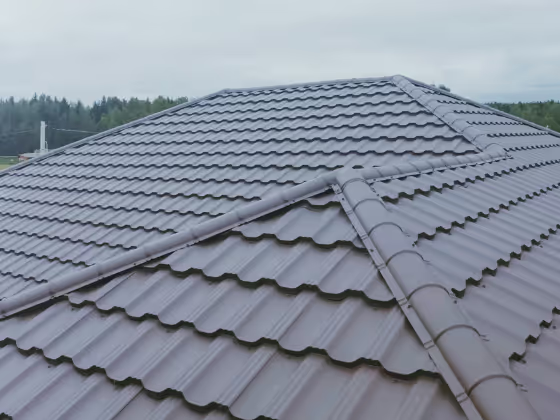
Standing seam: The premium tier
Short answer: standing seam is a concealed-fastener metal roofing system where panels lock together at raised seams — no exposed screws, longest lifespan, premium price.
Here's the big difference: AG, R, and U-panels all use exposed fasteners. Standing seam doesn't. Panels clip together at raised vertical seams, with the fasteners hidden underneath. No screws punching through the panel face means no washers to wear out and no obvious leak points to worry about in year 25.
Standing seam runs roughly $10–$17 per sq. ft. installed in 2026. Call it double or triple AG-panel. But it lasts 40–70 years with basically zero maintenance, and it's the only metal system that plays nicely with clamp-on solar mounts (no roof penetrations).
When a homeowner asks for "the nice metal roof," they almost always mean standing seam.
Standing seam vs. exposed-fastener: Quick comparison chart
Metal roof fastener install tips
Here’s where most new metal roofers f**k up. Metal roofing lives or dies on fastener placement.
It’s worth drilling these rules into your crew:
- Fasteners go in the flats, not on the ribs.
- Use fasteners with EPDM washers, not cheap rubber.
- Over-torquing screws leads to leaks and panel distortion.
- Under-torquing screws means uplift issues.
- Always align screws in perfectly straight vertical lines.
- Replace old screws on repairs (NO exceptions).
And one more tip that saves lives: always install safety lines.
Metal roofs are slick. Like really, really slick. Much more slippery than asphalt, especially in morning dew. So be cautious.
Common mistakes with metal roof panels
You’ll be miles ahead of other new companies if you avoid these rookie mistakes:
- Cutting panels with grinders (it burns off the protective coating)
- Not using closure strips
- Ignoring manufacturer specs for overlaps
- Choosing the cheapest paint finish (it fades fast)
- Ordering incorrect panel lengths
If you’re installing metal full time, get your crew trained on the right tools. The difference in quality is HUGE.
The best metal roof panel materials for 2026
Some of the strongest, most reliable panels on the market today include:
- Galvalume steel with Kynar 500 paint
- 26-gauge structural steel panels
- For premium homes: snap-lock standing seam
- For budget or rural work: a quality 26-gauge AG-panel
Roofing manufacturers doing good work right now include Berridge, Central States, MBCI, McElroy Metal, and Union Corrugating, among others. They all offer solid R-panel and AG-panel options.
When should a roofer recommend metal vs. asphalt?
Short answer: recommend metal when the homeowner cares about lifespan, weather resistance, energy efficiency, or modern aesthetics. Recommend asphalt when budget, install speed, or short-term ownership is the priority.
Here’s the cheat sheet. Recommend metal when the customer wants:
- Long lifespan
- Lower maintenance
- High wind resistance
- Energy efficiency
- Fire-safe materials
- A modern look
Recommend architectural shingles or another material when the customer needs:
- A more affordable option
- Faster installation
- Traditional curb appeal
- If they plan to move within the next decade
Metal is a VERY strong upsell when you know how to explain the long-term value. Now you know! So add it to your own offerings.
Want an easier way to sell metal roofing jobs?
Metal roofing doesn't have to feel intimidating. Once you get panel profiles and installation basics, it becomes one of the most profitable, reliable systems you can offer to homeowners.
If you're growing a roofing business, metal is a smart add-on. It sets you apart from crews that only do shingles or tiles, and it lets you charge premium pricing once your team is trained.
Need help quoting, measuring, or presenting metal roofing jobs? Roofr has your back.
Use Roofr to:
- Price out AG-panel or standing seam jobs in minutes with instant estimates
- Order super-fast measurement reports
- Build clean, professional proposals
- Send proposals to homeowners by text or email
Metal roofing FAQs
What's an AG panel?
An AG panel is an exposed-fastener metal roofing panel originally designed for agricultural buildings — barns, shops, sheds — with a corrugated profile, ~36" coverage width, and rib heights around 3/4" to 7/8". It's now widely used on rural residential projects as a budget-friendly metal roofing option.
How much does AG-panel roofing cost in 2026?
Roughly $4–$8 per sq. ft. installed, depending on gauge, finish, and region. On a typical 1,500 sq. ft. roof, that comes out to around $6,000–$12,000 installed. Always confirm with your local supplier, as steel prices are a moving target.
How long does a metal roof last?
Exposed-fastener systems like AG-panel and R-panel typically last 25–40+ years with proper installation and maintenance. Standing seam runs 40–70 years. Copper can go 70–100+.
Are metal roofs noisy?
With proper underlayment, decking, and attic insulation, a metal roof isn't noticeably louder than asphalt shingles. The "loud barn roof" reputation comes from bare metal on open framing, not how residential metal is installed today.
What's the minimum roof pitch for AG-panel?
Most AG-panels require a minimum 3/12 pitch. Standing seam can go as low as 1/12 or 2/12 depending on the panel. For anything below that, look at modified bitumen or another low-slope system.
Can you install solar on a metal roof?
Yes. Standing seam is the best roofing material for solar. Clamp-on mounts attach directly to the seams with zero roof penetrations, which preserves the warranty and eliminates leak risk.