

Physio Advice for Roofers: How to Prevent Aches, Pains, and Injuries
Summary
Roofing is physical labor, full stop. And most of us never talk about what that does to your body over 20+ years on the job.
For this episode of The Roofr Report, we're stepping away from our usual roofer spotlights to sit down with physiotherapist Colby Bucci, owner of the Center for Fitness, Health and Performance in Toronto, to talk about the injuries roofers deal with most, why they happen, and what you can actually do about it.
If you've ever pushed through back pain because taking a day off means not getting paid, this one's for you.
In this episode:
- The #1 injury roofers deal with
- Why repetitive strain — not accidents — causes most long-term damage
- The "big rope fraying" problem
- Three things you can do to prevent injury
- Proper lifting technique — back vs. legs
- Why hydration affects more than energy
- Back braces: helpful tool or crutch?
- The tough-guy mindset holding roofers back
- Is long-term damage reversible?
- Why roofers should train and recover like athletes
Transcript
Pete (00:01.75)
All right, what's up everybody? Welcome back to the Roofer Report. I'm your host, Pete McKendrick, and gonna take a little bit of a a step in a different direction here today. obviously, if you guys listen to us on a regular basis, you know we've been doing a lot of the roofer of the month where we are showcasing our you know, our some of our roofer users and and their journeys to the roofing industry and using our software and and also you know, a lot of industry folks on here, you know.
maybe you guys heard Dave from Dope Marketing and things like that, talking about a lot of like industry focused stuff and gonna take a little bit of a different avenue here today. And I'm pretty excited to to dive into this. I think that it's something that probably is not touched on nearly enough in our space. And so really excited today to welcome our guest, Colby Bucci. And Colby, I'll let you introduce yourself so everybody kind of gets an idea of what you're here for and then we'll dive into it.
Colby (00:56.488)
Awesome. Yeah, happy to be here. Thanks for the invite, Pete. My name is Colby Bucci. I'm a physiotherapist based out of Toronto, Ontario, up here in Canada. I'm also the owner of a multidisciplinary clinic here, the Center for Fitness, Health and Performance. So we've had a clinic here in Toronto for about 38 years now. So the clinic itself is we're not strangers to all different types of injuries and whether it's rehab from acute injuries or
you know, helping the prevention for the future. It's kind of what we do best here. It's our bread and butter. So yeah, I'm just here helping people get back on track, whether it's sports injuries, workplace injuries, which we'll touch a lot on today. just helping people feel better.
Pete (01:38.145)
Awesome, man. Yeah, I think that this is something that we really don't address, right? And I think that we're in an industry like I used to work out in the field. You're in an industry where it's very easy to get injured, right? And a lot of physical labor, a lot of heavy lifting, these types of things. And so the chances of getting, you know, injuries that could potentially result in chronic injuries or chronic, you know, issues later on, are very high. You know, and I don't think that we
address it enough, I think that we just kind of roll with it and say, like, it's just the nature of the business, right? And, you know, hopefully someday I'll own my own roofing company and I won't be on the roof and have to worry about the physical part of it. I know that's quite honestly that's one of the reasons why I moved out of the field and behind a desk, right? Because it was just like, hey, it's physically getting tougher and tougher every day. And as much as I enjoyed being out in the field and dealing with customers and being out there, like it's physically taxing. Like it takes it out of you. And so
Colby (02:20.188)
Yeah.
Pete (02:36.216)
Talk a little bit about like maybe some of the common blue collar injuries that you guys see on a regular basis.
Colby (02:44.945)
Yeah, and I think you hit it like right on the head there. It's it's not just thinking about can I push through the pain today, right? Because that's gonna chip away. And then can you do this for the next twenty, thirty, forty years? And not everybody enters the space to be able to own their own company where they can sit behind the desk, right? So if you're gonna be like grinding out there the manual labor, you gotta take care of your body. blue collar injuries, especially for occupations that are very physically taxing, the number one
In that space, even the number one muscle joint disability worldwide for any job is low back pain. So that's by far what we see and deal with the most. And that can be acute, you know, you bend over to pick up a box and then you herniate a disc. It can be that aggressive, or it can be the long chipping away, nagging, kind of aching pain. And sometimes that's more debilitating than ever because it can last for like years. So
Low back pain, roofing, you know, you're you're lifting a lot. You're bent over. When our spine is in that like flexed, rounded posture, that's like the most vulnerable position for it. On top of that, you add twisting, reaching for tools, reaching for equipment, right? It's just a recipe for for low back pain. So that's by far the number one injury that we that we see and that we treat. Otherwise, we treat a lot of shoulder injuries as well. It's close up there too.
You know, there's a lot of times we're working overhead, whether it's at at work or in the gym, overhead activities really cause a lot of strain on the rotator cuff tendons of the shoulder, the muscles that cross our shoulder joint here. wrist, elbow, you know, using power tools. If we're on our hands and knees and we're leaning onto our wrists, we get a lot of wrist injuries. And then knee pain is probably the the last one that we see a lot of, especially in these types of jobs, climbing ladders, kneeling all day.
Right, it just takes a toll day after day, year after year.
Pete (04:45.848)
Yeah. I think one of the things that doesn't get talked about a lot too when we talk about these injuries is the repetitiveness of it. Like I'm a a youth sports coach, right? And we talk a lot about kids becoming like really specific in a sport early on. And what you tend to see is these like repetitive injuries, and the parents don't understand. Like if that kid's doing that same sport five, six, seven days a week, right? Like that repetitiveness ends it adds up, right? And the same thing in this case.
Colby (04:55.526)
Mm-hmm.
Pete (05:13.442)
You know, if I'm on the roof six days a week doing a similar task every single day, how much does that repetitiveness affect these injuries that you're talking about?
Colby (05:26.181)
Yeah, it's like number one, like we see a lot of acute injuries, like sports injuries or car accidents. Sure, we see that too, but ninety percent of our it's all good. Like probably close to ninety percent of our practice is repetitive strain injuries. So whether that's again harder physically demanding jobs or just people who sit behind a desk, right? Every job, every hobby, every sport has a repetitive nature to it. So
Pete (05:34.424)
Sorry.
Colby (05:53.212)
When we're young, we get away with it, right? It hasn't had the amount of years to chip away yet. But often I'll tell people, especially if we're talking about muscles or tendons, it's like a a big rope, right? And slowly it starts to fray. And then at one point it's either gonna say pain, and hopefully it does that first, so you have a message, an alarm, or it might snap, right? So we don't want to wait until that big bad moment. Even if it's a subtle pain, but it's repetitive and it's every day. We wanna try to address it.
Pete (06:23.372)
Yeah. Yeah. I mean, I'm like I said, I'm involved with you know, youth sports and you see it more and more like kids specializing and it becoming more and more of an issue in that where like I even have some friends right now whose kids are experiencing some injuries that are becoming almost chronic, right? Like where, hey, this is the second or the third time that he's had a knee injury, you know, in a short time, you know, in this sport.
Colby (06:30.554)
Mm.
Pete (06:50.38)
Because he's literally just focused on this and doing the same type of workouts and the same type of practices every single day.
Colby (06:57.927)
Yeah, and I think we're seeing more and more in the younger population, like you used to never think of like a fourteen year old kid as having chronic knee pain already, right? But I think and especially you mentioned you're down in the States, right? And and in the States it's huge for youth sports, right? And I kids are just getting pushed harder and harder to like get to that elite level. So whether it's kids or adults, and especially in this industry, what we also don't talk about enough is recovery.
It's like we're working, I don't know, roofers. I have a friend who's who's a roofer. My family have done it. They work sometimes what twelve plus hour days. And then you get home, the last thing you want to do is like a stretching or a rehab routine, right? Or you just aren't aware that that's something you should be doing. So it's repetitive strain, get home, eat, hang out with family, sleep, wake up early, repeat. Right? Same with kids. It's go sport, da da da. Next okay, tomorrow's another practice. What are you doing with your school team? What do you do your competitive team?
Pete (07:36.654)
Yeah.
Colby (07:53.712)
So the recovery piece to allow these repetitive stresses and inflammation to calm and heal is super important as well.
Pete (08:00.994)
Yeah. And when you talk about recovery, not only on a daily basis, right, but sometimes it takes time away, right? Like from that specific task, you know, and that that could be more than just an afternoon off.
Colby (08:07.14)
Mm-hmm, mm-hmm.
Colby (08:15.279)
Yeah. And it's always the hard thing that we have to tell people whether it's their favorite sport or their job. It's like honestly, like this will not get better unless we have and sometimes only like one, two, three weeks, but we need that period of like protection of the tissue to allow it to like get to that first healing point and then we start to challenge it again in a safe way. and that's the other thing too with with roofers.
Is that sometimes you're not always like on this beautiful salary with sick days and leave pay. So you don't work, you don't get paid. So it's like this catch 22 where they're like, I'm really in pain, but I I need to work. So I'm not gonna take time off. But then they keep working and then they get really hurt. Now they're forced to take time off. So it's like, yeah, taking that short recovery time can sometimes make it not a a bigger issue down the road.
Pete (08:43.746)
Yeah.
Pete (09:04.29)
Yeah. And how how likely are some of these injuries to become like you said, like if you don't if I don't take that recovery time or I don't necessarily address it, what are the what's the likelihood that it's gonna become some type of a long term issue for me that maybe I'm gonna deal with long after I'm a roofer?
Colby (09:21.797)
Yeah, I mean it's it's pretty high, especially if we think like whether you think or you're talking to a professional that the the pain or the irritation is coming from like say the task or a repetitive nature of your job, right?
If we think that's the cause of it or or one of the causes, that's gonna be there on Tuesday. Then it's gonna be back on Wednesday, right? It's not going anywhere. So it's just gonna keep compounding. And we always tell patients, like the sooner you can act on something, the faster we can reverse it, right? If it's been twenty years, we can still help you out, but it's gonna take not three weeks to get better. But
Pete (09:41.366)
Yeah.
Colby (09:58.372)
No one really has escaped, like they're not in pain for three years, and then magically one day they're better, right? It usually stays or gets worse, unless you do something about it.
Pete (10:08.206)
Yeah. Is there a point where potentially it becomes a permanent it becomes permanent damage or is it is there an opportunity to be reversed? You know, let's say I worked twenty years and I've never even given this any thought and I hear this podcast and I'm like, yeah, my lower back was hurt for the last fifteen years. Like, you know what I mean? Is there is there still time to save it more or less?
Colby (10:18.523)
Mm-hmm.
Colby (10:29.243)
Yeah, so we we kind of follow the train of thought here that there's always something that can be done to help improve your symptoms. You might have severe degeneration in your spine or osteoarthritis, like wear and tear in the knees, for example. That wear and tear, that degeneration of the bone cartilage, that's not gonna regrow or heal. That's permanent, but you can get to a point where you don't have pain.
So it's kind of like having that conversation with the patient, being like, here are the things that you've done, here's the things that we likely won't change. Like if you start to like really round with your posture and you're 60 years old, are we gonna make you nice and tall again? Probably not. But can you live a comfortable, pain-free life even with those degenerative changes? Yes. Otherwise, there's this crazy world of chronic pain. So there's something called no C plastic pain.
So this means that there was an injury, it's healed, but because it's maybe been chronic in nature, the nerves and the brain and the nervous system are still saying it hurts. So it's not actually something hurt anymore, but your brain is perceiving pain. So that's a whole nother conversation. But even then, there's different types of therapy, cognitive brain therapy, working with like talk therapy, chronic pain specialist that could help.
manage or cope with your pain. So I don't like to ever tell patients that like, you're doomed forever. Right. There's nothing you can do about it. You have to have realistic conversations where it's like, you're a six out of ten. If we can get you to a two out of ten and teach you ways that you can manage this pain and still enjoy the rest of your life, then that might be the win for you in your situation. But even then that's usually pretty extreme.
Pete (11:59.817)
You're stuck. Yeah.
Pete (12:16.588)
Now, what are some things that I could do as a roofer, right? Like let's say I'm out there on the job, like you said, I'm climbing ladders, I'm kneeling a lot during the day. What are some preventive things that I could do to potentially save the, you know, myself from some of those injuries?
Colby (12:31.813)
Yeah, I think it's kinda like threefold, right? So and you treat it like a sport. There should be some type of warm up before you get on the roof. Okay. And this doesn't have to be like go run two laps around the block or anything like that. But and I'm just using my some of my friends as reference that work in the industry, like he'll be driving to a site at four thirty AM, like in the middle of winter.
Pete (12:45.238)
Yeah.
Colby (12:55.279)
So your tissues are not warmed up yet, right? So even if it's something simple as like, you know, doing a couple movements, a couple stretches, circles, rolling your neck, trying to mimic some of the activities or positions you might be in before you get up on the roof. That's always step one. Instead of going in like, all right, we're here, let's start hauling shingles, right? Cold, warm up the tissues a little bit, get the blood flowing. Same as with sport, right? Same concept. so that's that.
Pete (13:15.276)
Yeah. Yeah.
Colby (13:24.197)
The second piece is the recovery part we talked about, right? So after a long day, it might be going to a massage therapist, getting massage once a month. It might be doing home exercises, home stretches, icing if something feels sore, try to get some inflammation down. So many things that you can do for for recovery purposes. Sleep, very important, getting quality sleep. Again, that can be hard if you're working late, have a commute home, waking up early the next day, but trying to manage that.
And the third piece for injury prevention is strengthen the tissues, right? You gotta like just make your body as strong as it can be to handle the load that it's gonna be put on. Because we don't have the luxury to just be like, my back's and my core is a bit weak, so I'm just not gonna be a roofer tomorrow. I'm gonna switch. I'm gonna be a lawyer, right? Like, so if that's the the industry that you're in or that you're passionate about, you just gotta prime your body to be ready for that. So working on your core.
Pete (14:16.205)
Yeah.
Colby (14:23.824)
working on your your entire back, your glutes, your quads, hamstrings to support your knees, all these kind of your rotator cuff tendons with bands even. Doesn't have to be anything crazy. It can be stuff you do at home, but just strengthen the tissue so that they can handle what you're about to do to them for the long haul.
Pete (14:41.548)
Yeah, and I think it's interesting, like you you touched on it there, like it's a lot of full body, right? Like you you really gotta have like a full body kind of being sound. It's not like, you know, hey, I'm gonna be lifting shingles, so let's go do some bicep curls, right? And if my arms are huge, I'll be good to go, right? Like you're still climbing a ladder, you're still gonna have, you know, all these other things involved. And I I think that we don't necessarily take that into account a lot of times. Like you you meet a lot of roofers and y you see, you know, a lot of these guys
Colby (14:59.92)
of a sign.
Pete (15:10.476)
Go to the gym on a regular basis, but maybe not tackling things the way they should, you know, to help prevent some of these injuries.
Colby (15:15.963)
Yeah.
Especially because like when you're younger, you're going to the gym to like, I'm gonna try to get as strong as I can, get jacked, look good at the beach, right? You're not thinking functional, right? When you're older, you start going to the gym thinking like I need to be able to pick up my kids or do my job, right? So it changes then, but it hopefully we can start to instill this in the younger kind of generation. But yeah, it's exactly that. It's just doing the exercises and the important ones. And the core is often overlooked too, right? People think.
I got a six pack, I have a good core. But those muscles in the front are just for show, really. The core are the ones that like are deep into the spine and stabilize the spine. So with bending, twisting, lifting, that's the stuff that's gonna lead to that number one global disability, low back pain, right?
Pete (16:08.386)
Yeah. What are some things that I could specifically do? Like if that's if that's really like a main area of focus, like what are some exercises that I could do to work those specific core? Like you said, the fronts for show. Like I think that's what everybody thinks of when they think of core, right? Everyone thinks of abs and those type of exercises that do that. Like what are some things that I can do to focus on those other muscles that are gonna do more to actually support me?
Colby (16:11.824)
Mm-hmm.
Colby (16:19.813)
Yeah yeah yeah.
For sure.
Colby (16:32.91)
Yeah, there's so many things you can do for core. The one thing that'll start with though you'd want to probably avoid is like crunches or sit-ups. So again, like a sit-up, people also think core, I'll do sit-ups. But that again takes us into that flexion posture that we're saying is hard on the spine. If you have a really strong core and no back pain, you can get away with sit-ups. But if you're new to it or a weaker core or have pain, you probably want to avoid that. So things that keep your spine in neutral or straight are a good place to start. So like planks.
Right, and you can do them on your wrists or on your forearms if you have painful wrists. Planks are really good. Side planks if you can tolerate it. on your back, there's an exercise called the dead bug. So it's kind of where on your back you have your knees up and your arms and legs are moving. I don't know if you've ever like seen that one. So it's like a bug stuck on its back. again, your limbs are trying to take your spine out of neutral, but your core is working to keep it in neutral. That's where the word comes in.
Pete (17:19.128)
Yeah.
Colby (17:31.781)
Reverse that on all fours. There's an exercise called the bird dog. One arm out, one leg out, the back, right? While trying to maintain the pelvis and the spine for not moving. So those are really good quality, safe exercises. Usually I just tell my patient, like, do those three planks, dead bug, bird dog, just do a circuit through them until you're fatigued or tired. And then that's your core workout to start.
Pete (17:37.565)
yeah, yeah. Yeah.
Colby (17:54.641)
Then you progress it to doing things with some rotation away from the body because again, not everything in life is just still straight. Yeah. Farmers carries, that's actually a really good one. Do you know that exercise? So I think this is a really good one because it's a good core exercise, but also I think you do it every single day as a roofer. It's where you're literally just in one hand or both, one hand's harder, you hold a weight, like a dumbbell, and you just walk.
Pete (18:05.165)
Yeah.
Pete (18:09.038)
I don't know that I know that.
Colby (18:23.31)
and don't let the dumbbell move you so you gotta keep your core really tight. So I that would translate, I'm sure, 100% to your job lifting a toolbox or right? So if you're like leaning like this, one side's working harder than the other, you're gonna get back pain. Right?
Pete (18:31.32)
That yeah.
Pete (18:38.284)
Yeah. Yeah. I definitely could see how it would pull you out of whack, right? Like
Colby (18:42.906)
Yeah. So if you don't let it, that's where the the work comes in, the exercise.
Pete (18:46.54)
Yeah. Yeah. When I was younger, I was I played baseball and I actually ended up with like mild scholiosis just from throwing a baseball. Like something as simple as that. Like you wouldn't think a baseball weighs nothing, right? But because I was younger and I was throwing it consistently, it actually the muscles started to develop inconsistent and it started to literally push my spine over, right? So you you don't even think of things like that until they happen, you know. What about like go ahead, go ahead. No, I was gonna say.
Colby (18:50.406)
Mm-hmm.
Right. Yeah.
Colby (19:05.306)
Yeah, yeah.
Colby (19:10.992)
It's like what's a saying? Yeah. I was just gonna say it's that death by a thousand cuts, right? It's like one little cut's not gonna hurt ya, but you do it tons of throws, eventually something's gonna give.
Pete (19:17.09)
Yeah. Yeah.
Pete (19:23.456)
Yeah. Now what about like bracing and things like that? I do see some guys on the job side that'll wear a back brace or or something like that. how much is that helping? Is it potentially hindering in a way? Like maybe do we need to still do both, right? Like I I think that some people wear it. Yeah, I think some people wear it like as a preventive, but they don't necessarily strengthen the core, right? And they're hoping it'll offset it.
Colby (19:26.745)
Mm-hmm.
Yeah, absolutely.
Colby (19:39.236)
That's exactly it.
Yeah.
Colby (19:48.293)
Yeah, so bracing is amazing at the right time if if needed. I always recommend for whatever part of the body you're wearing a brace, usually there should be some strengthening with it. Otherwise, you're just gonna have to rely on that brace all the time. Right? A brace should be either when you when you have a vulnerable area like your back and you know you're gonna be doing something really, really heavy. And in that moment, you should probably stop and be like, should I ask for help? but
You want to wear it during a recovery period while you're doing your rehab or your exercises so that eventually you get rid of the brace. So some people like, you know what, I feel totally better. My my injuries healed, but I'm still gonna wear it when I work because I just wanna just peace of mind or make sure. And that's totally fine as long as you've done the work at some point to make your natural brace strong.
Pete (20:34.636)
I like it. Yeah. What are some other tips that you would give to a roofer, you know, as far as just things that are gonna make their life better, their quality of life better on the job site?
Colby (20:35.802)
Yeah yeah.
Colby (20:46.436)
Yeah. I want to circle back. I don't want to forget to mention proper like lifting technique. Right. So that that's a big one, right? So it's just a few points, super simple. When you're picking something up, preferably it's from waist height, but that's not always the case. Sometimes you pick things up from the ground. But the load or whatever you're picking up should be as close to your body as you can make it. So when we're lifting something out way out here, it's a lot harder on our low back muscles than if it's close to our our our center.
obviously you've heard, you know, lift with your knees or with your legs, not your back. So we call it a hip hinge, and that's where you kind of keep your back straight and you push your bum out as you bend your knees versus just rounding over. So using your legs and your big hip muscles to help lift that object is really important as well. And then trying to avoid twisting when you pick things up. Face the box. Don't grab over here, which I'm sure happens a lot, right?
So it's just all these little things that you do have to stop and you have to like check in and like, wait, I gotta be doing it like this at first until it becomes more of like a natural rhythm. But it's just those funny moments where everything sometimes seemed totally fine. People are I never had back pain. And then they go to bend that one wrong way and something goes. Right. So we would want to do whatever we can to avoid that. yeah, I mean, that's a tip. We talked about warmups, we talked about
The recovery period, sleep, hydration, that's a huge one too, especially working in those summer months. Like it's crazy. I keep going back to my friend, but sometimes I'm like, there's no way you're working today. This can't be safe. Like it's like forty degrees out or whatever.
Pete (22:12.706)
I was gonna say. That's the one I was gonna bring up. Yeah.
Pete (22:20.062)
Yeah. Yeah. I mean, I don't I yeah, I literally just talked to a guy today who's like he said, My roofing company is in California and it's been incredibly hot there, like into the high ninety. I mean, even here where I live, I live in western Kentucky and it's been like unbelievable. I mean, he we're you're talking heat indexes pushing one hundred and fifteen degrees Fahrenheit, and it's like, you know what I mean? Like that's crazy to think of that there's guys up on a roof.
Colby (22:29.754)
Mm-hmm.
Colby (22:34.426)
Yeah.
Colby (22:42.682)
Yeah, yeah, yeah.
Pete (22:48.148)
in that heat for that amo like you said, sometimes ten, twelve hours in a day, you know, and so yeah, like talk a little bit about the hydration and how that t potentially puts you not only obviously at risk of what you think, right? Like passing out and things like that, but at a higher risk of injury.
Colby (23:05.178)
Yeah, so when our body's dehydrated, everything goes a crab. But specifically our our muscles actually will like get tighter.
Right. And be more prone to like meeting that like snapping point. Right. Like they're not as like supple and full of water. Same thing goes with our spine. We have these discs in between each of our vertebrae, the bones of our spine, that absorb and and fill with fluid. So if we're chronically compressing them with like bad postures or movements or dehydrated, even on it's not like it dries up totally like a desert, but
Even a little bit extra, it's gonna make less compressive shock absorption. And then it's just bang, bang, bang, and then the disc can irritate the nerves that come out of the spine, herniations. So from a muscle joint perspective, water is paramount. And then, like you touched on too, you know, just from like not passing out, headaches, heat stroke, all this stuff, we don't wanna go down that road either. Mm-hmm.
Pete (24:00.323)
Yeah, and so it from the sound of it, it sounds like, you know, obviously we're we're at a risk of injury all the time when we're on these job sites because of the things we're doing, but the lack of hydration could potentially turn those into a much more serious injury than potentially if we were hydrated.
Colby (24:18.064)
Yeah, I can make it more serious or just bring it on sooner than it maybe would have if you were hydrated, right? So instead of I got back pain when I'm fifty, you had it when you were forty. And that's just ten more years of annoying back pain and limiting your ability to have a good life. I think like and then obviously most roofers are are male, right? So I think and probably most of them play or watch sports. So I think we just need to like you need to treat your job
Pete (24:28.024)
Yeah.
Pete (24:38.861)
Yeah.
Colby (24:46.798)
Especially a physical job, as if you're an athlete. Right? Like we talked a lot about these two similarities today. So it's like you should be warming up, you should be recovering, you should be having protein after a big work day, right? Treat it like a workout, like you played a sport or match that that night. Like same kind of idea.
Pete (24:52.968)
yeah. A lot of correlation between
Pete (25:03.468)
Yeah, super smart. I mean, it we draw a lot of correlations between sports and roofing and you know, from running a company to being part of it. And yeah, I mean, it makes perfect sense, right? Like it's all the same movements, right? In the same similar conditions a lot of times, you know, with like you said, the heat and the cold and all these extremes that you potentially are gonna play sports in as well. So yeah, a lot of correlation between the two. And I think that's a great way to look at it, right? Like think of yourself as
Colby (25:07.974)
Mm-hmm.
Colby (25:13.754)
Yeah, yeah.
Pete (25:32.544)
an athlete, you're right, like you wouldn't you know, your warm up wouldn't be finishing a cup of coffee at four thirty in the morning. Yeah, you know what I mean? If you were yeah, exactly. If you were going to, you know, play a football game, right? Like, you know, so
Colby (25:39.748)
A Red Bull. Yeah, yeah.
And honestly, like roofing is probably harder than some sports physically. Right? Like if you're like, you know, not like golf's easy either, golf's super hard and challenging on the body, but like it's not as like as like a day on the roof, right? So they do good warm-ups, they take care of their body, right? Why aren't we in in different occupations? I think another big thing too, and it's kind of human nature, but again, when we talk about industries that are
Pete (25:51.982)
Yeah, potentially, right? Yeah.
Pete (25:59.289)
Yeah.
Colby (26:13.84)
predominantly male dominated. It's just that kind of silly, no, I'm I'm tough. I can handle it. I'm not gonna go see somebody, right? Whether that's like physical or mental therapy. But it's just like kind of getting over that to just be like, go get checked out, right? See somebody for it. No one's gonna judge you. None of the guys at work are gonna be like, you're weak, you're soft, right? Because they're probably all experiencing the same thing or they're going to one day. Right. So getting over that kind of hurdle.
Pete (26:40.524)
Yeah. Well and I I think like Yeah. I think like you even brought something you mentioned something earlier that I thought of like when I was out in the field, right? Is like don't be afraid to ask for help, right? Like recognize a situation where you're in over your head or this is potentially gonna result in an injury. And don't be afraid to say like, yo, can you grab you know grab the other end of this or help me with this? Because I think, you know, like you said, that kind of like male bravado thing like, no, no, I can do this, right? Like
Colby (26:49.562)
Mm. Yeah.
Colby (26:58.874)
Yeah.
Colby (27:09.711)
Yeah, yeah.
Pete (27:10.238)
I'm not I i I'll look weak if I ask somebody for help, you know, and like I've been out there, I've seen it happen, you know, and it's like, Yeah, you're weighing over your head, you should never pick that up.
Colby (27:18.852)
Yeah. Especially like I'm sure like the younger guys are trying to like prove themselves or like work their way up, right? Are like, No, I can do this and and again, you're on roofs. Like that's dangerous. Like something could seriously go wrong. We talked a lot about repetitive strain and chronic injuries, but there's like the acute side too. There's falls, there's fractures, there's like all this stuff too that just be smart and and don't put yourself in those situations to begin with, right? yeah. But
Pete (27:24.013)
Yeah.
Pete (27:36.963)
Yeah.
Pete (27:42.38)
Yeah. Yeah.
Awesome. Well this has been great, man. I I go ahead.
Colby (27:48.007)
Do you guys sorry, one I was gonna say, do you is it typical like in the industry to have like health benefit plans and health insurance coverage? I know it's different in Canada to the states, but like is that a barrier where people are like, I just don't I won't get reimbursed or I have to pay out of pocket for these services? That's why I don't go to a physio or massage, whatever.
Pete (28:02.125)
I think
Pete (28:10.124)
Yeah, I think a lot of it depends on, you know, the size of the company that you work for. You know, a lot of the the a lot of the labor force in our industry works specifically as subcontractors of maybe other companies, right? A a company's gonna hire you to be just their labor force. And so because of that, a lot of times maybe you aren't covered, right? Like maybe you don't have the luxury of saying, like, you know,
Colby (28:14.118)
Mm-hmm, mm-hmm.
Pete (28:35.594)
If I do get hurt, I'm covered. I've got insurance. Right. Like I know a lot of the guys when I was in the field, we did not have it. We had to go get it ourselves. you know, if you wanted it. And so, and I think that could be a blocker, but it, you know, like what we're talking about here today, that's even more of a reason to take these steps and say, let's hey, let's not get hurt. Let's not have these chronic problems because, you know, I don't I'm not necessarily in a great position to just go have it treated, right?
Colby (28:54.96)
Yeah.
Colby (29:02.852)
Yeah. And I wanted to bring it up too because we hear that a lot here too, right? With whoever's coming in, they're like, Listen, I can't afford to come here twice a week for six weeks. Right. And some people also have this idea that if I go to the chiropractor, the physical therapist, then I have to go forever.
If you're if you actually find a good therapist who actually genuinely cares about you getting better, not filling their schedule, sometimes it's as even as like, okay, good, we're having this honest conversation. Here's what we assessed today. Here are a few tips and exercises. Go do them at home. At least start with that. Right? So that's why I tell people if they feel like I can't afford it or whatever. It's like just try at least the one session. Get some.
At least know what's going on with your body. Get some education on that piece and some tips and stuff that at least you're not in the dark anymore and you have some direction. And even sometimes the I'll be like, okay, listen, you can't come see me, that's fine. You live far away, you don't own the money, whatever. Do this, this, this. I'm gonna send you some links of YouTube and like follow the videos, right? Better than sitting around thing, what's wrong with me? What do I do? So again, that should just be like
If you can afford that one session, at least start with that to at least get some insight into what can you do at home for yourself.
Pete (30:14.232)
Yeah, and like it kind of goes back to what you were saying earlier. Like there's always a way, right? Like there's always a way that we can figure out to fix it. And regardless of your situation, there's there's gonna be a way that you can figure out how to, you know, potentially help yourself out and and and get better. So yeah, man. I mean, this has been awesome. I really appreciate all the insight. I think this like that, you know, I think like we talked about, you know, I think there's this kind of, you know, this mindset that like
Colby (30:19.022)
Yeah.
Colby (30:33.902)
Yeah, yeah, it's been a lot of fun.
Pete (30:41.986)
We're all tough in this industry. We don't necessarily need to do these things and we'll be okay. Right. But yeah, yeah. I mean, like I used to work, you know, in I used to work for UPS and the amount of injury like chronic injuries we would see because of those guys, the heavy lifting and the the things, you know, like the the repetitive movements and the up and down the stairs all day long. Like you don't think you're like, these guys are in good shape, like they're moving all the time, but you know, it's a lot of
Colby (30:45.933)
Yep, yep. Tough till you're not. Yeah.
Colby (30:58.053)
Mm.
Pete (31:11.658)
like impact type of stuff and and a lot of injuries. Those guys, you know, suffer a lot of long term effects from it. And the same thing in in the roofing space. So
Colby (31:13.615)
Yeah.
Colby (31:21.219)
Yeah. It's like if if the pain is worsening, if it just keeps coming back, or if it's like impacting your your mobility or the way that you walk or move, those are usually the three signs like you gotta do something about it. If it's just a one random day where you're like knee hurt, okay, don't freak out. Right? It might just been a a tough weird day on it, but if it's recurring, change the way you move or operate, or obviously getting worse, then then you need to address it. But we always like we tell people like this, like
You maintain your tools, you maintain your truck, but your body is like your number one piece of equipment. So why aren't you maintaining that? Right? So yeah.
Pete (31:57.292)
Yeah. Yeah, very smart. Yeah. We always talked about understanding the difference between like when I played sports, you always say say understand the difference between soreness and pain. Right. Like it's one thing to wake up in the morning and be a little sore, right? It's another thing to understand, recognize the pain and and address it appropriately. So
Colby (32:08.205)
Yeah, yeah, yeah. Like hurt versus harm. Yeah.
Colby (32:16.835)
Yep, yep, absolutely. Yeah, great. Well, so yeah, yeah.
Pete (32:18.926)
Cool, man. I appreciate I really appreciate this. I mean, this has been great. lots of good information here. And I think that, you know, hopefully the guys listening take something away from it and maybe change maybe make some lifestyle changes a little bit in the way they approach things. I think that the analogy that you made between like the sports and treating yourself more like an athlete than just a roofer, right? Is is great, right? And if you think about it that way, I think you approach it from a completely different angle and
Colby (32:39.845)
Mm-hmm.
Yeah.
Pete (32:49.122)
you know, take maybe take a little bit better care of yourself, preventively at at least, you know.
Colby (32:54.051)
Yeah, yeah. Just relive those those dreams of not making it to the show, you know?
Pete (32:58.306)
There you go. That's how you can do it, right? Yeah, that's it. Well, man, I really appreciate your time. I I really appreciate everybody listening. Yeah, absolutely, man. Anytime. We're always welcome here. And the great, great stuff, like I said. And a great topic, right? Something that does hardly gets talked about and probably should get addressed on a much more regular basis than it than it is being addressed. So I really appreciate it.
Colby (33:01.463)
Yeah, yeah, yeah. I'm an athlete again.
All right, man. Yeah, I appreciate you having me here.
Yeah.
Colby (33:17.188)
Mm-hmm.
Colby (33:20.856)
Yeah.
Yeah, yeah. All right.
Pete (33:25.62)
Awesome, man. Well, thank you everybody for listening. Thank you again for Kobe being our guest today. And we look forward to talking to you guys next time on the Roofer Report. Thanks, everybody.
Additional resources

How to Prevent Aches, Pains, and Injuries: A Physiotherapist's Advice for Roofers
Roofing is tough on the body. Get some tips from physiotherapist Colby Bucci on how to stay limber and prevent injuries over the long-term.
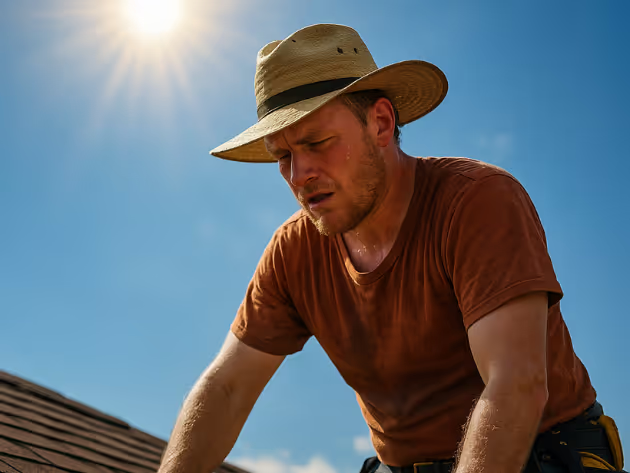
Managing Roofing Crews in Hot Weather: Summer Safety Tips
Prevent heat stroke, stay hydrated, and keep your crews healthy all summer with these tips.
Roofing Safety Gear and Equipment: The Business Owner’s Essential Guide
Arm your workers with the right tools. Don’t rely on bad roofing equipment just to save a buck!


More episodes
.png)
Cross-Training Crews to Survive Buffalo Winters (w. Chandler Pedini)
Chandler Pedini, our October 2026 Roofr of the Month, cross-trains his in-house crew on other trades to keep them busy year-round. Check out his story.
.png)
Staying Lean, Winning Retail, and the 60 Second Response Time
Owen Atherton, Roofr of the Month for September 2026 and a first-year business owner, shares his strategy behind staying lean, marketing everywhere, and responding to everyone within 60 seconds.
.webp)
Referral Partners and the New Rules of Marketing (with Michael Stearns)
Michael Stearns of Ascend Digital talks referral partners, AI marketing tips, and why chasing lead volume is the wrong approach for roofers.
