

Connection, Authenticity, and Caring the Most with Chuck Allen
Summary
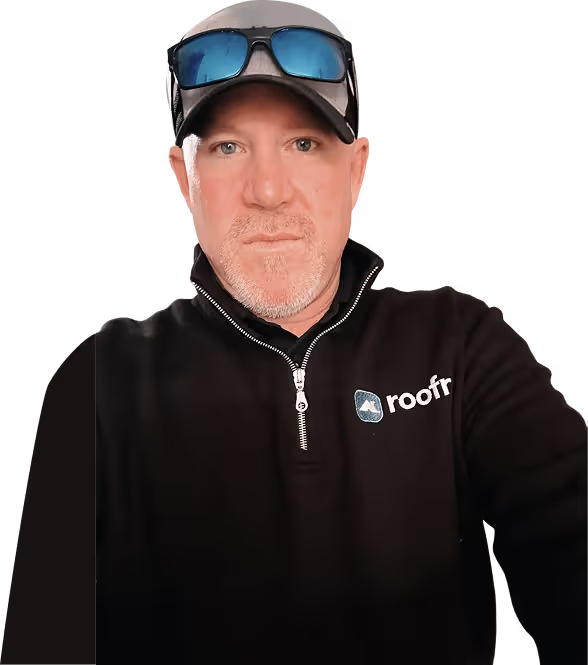
This week, Pete catches up with Chuck Allen, our February Roofr of the Month.
Chuck shares his transformation from crane operator to roofing business owner at San Antonio’s Rio Blanco Roofing. Chuck’s been around the block, and shares some great business insight into:
- Targeting your clients instead of casting a wide net
- Building your brand by being honest and authentic
- Keeping quality service and high production standards
- Setting proper customer expectations
- Leaning on the right tech, and the right people, to grow without waste
Learn how Chuck and his team have set Rio Blanco apart in a highly competitive market — and how your own roofing company can follow a few key principles to achieve the same.
Transcript
Pete: All right, everybody, welcome back to the Roofr Report. I am your host, Pete McKendrick, and we are back with another great story here.
We've recorded a bunch of these and just some fantastic stories and what a mix we've had of contractors on, you know, some just rolling their business out, people that have been in business for 18 years, handing the business down. Excited for today, to welcome our February Roofr of the month, Chuck Allen.
So welcome, Chuck. Excited to have you, man.
Chuck: Man, I'm fired up to be here. Pete. And I listen to the varied people's backgrounds that you have. And one thing I will say about me is I think I'm a mixture of all of that stuff combined. So. Yeah. Content today is not gonna be hard. We've got a lot to discuss and it's an honor to be here.
Pete: Yeah. And a little bit of background here, and I'm gonna let Chuck dive into it, but you know, Chuck has been a Roofr user since Dang near the beginning, right. Chuck, I mean, Chuck's been with us for this ride for a very long time. And, he's seen this company evolve.
So. Excited to have Chuck on today and to be Roofr of the month here for February. Let's dive right into it here. I'm gonna let you give a little quick introduction to yourself and the business. If people don't know, Rio Blanco, a high level overview of where you guys are located, how big is the company, and, how long you guys have been around for.
Chuck: Yeah, so Rio Blanco's here in San Antonio. The company's been around since 2014. I, myself, have been involved since 2019. We bought it from the original owner who was looking to retire and get out of the industry. God bless him. I think he found a way to actually get out of it. So we bought the company in 2019, built it up, had a really good run, and had a transfer of ownership back at the beginning of '24.
Bought the company from myself and a couple buddies, which is kind of a strange, you know, sounds weird, but I've been involved with it the entire time through a couple different groups now. And we're working on 2026 being the biggest year yet for the company. And, I'm ecstatic because my new partners that I've got, we've got a diverse group with some experience, in all facets.
And I think that's important right now. I think having experience and knowing what we're doing. Is really gonna shine in the coming years because of the things that are going on in the industry.
Pete: Yeah. This will be a really good conversation because you've been in it about as long as I've been in it here.
You know, obviously I've been on the tech side of it. You've been out in the field here, but this evolution of the industry has just been. Incredible. Right. Especially like over the last three to five years, we've seen a big change in not only the customer, but also in the way people are running roofing companies.
Like you had this first chapter of Rio Blanco. And the way that things were and the second chapter now with a completely different kind of look to the industry and to the customer base. So yeah, excited to dive into that today.
So let's get a little backstory on Chuck, though. How did you come into the roofing space? Because we always joke, you know, you don't find roofing. Roofing finds you. How did you end up becoming a roofer and ended up with a roofing business?
Chuck: It's been an amazing journey and really what happened was 28 years ago, on a Friday, I was having a bad day at work. I used to, run a crane and I'd load drywall into commercial buildings and new construction.
And if there's anything that's more physically difficult than roofing, it's drywall. And in my early twenties, I realized that I didn't think that my body would be able to last that long, so I took the next logical step. I went to a roofing supply company and applied to be a truck driver. I drove a conveyor truck and roof loaded houses for 12 years and then I got an opportunity to actually relocate to North Carolina, Charlotte.
We opened a branch of that company up and I got to be right there from day one literally of building that from scratch and kind of building up a supply company. That taught me a lot about our industry because I got to work with a ton of different contractors. I got to see how different people did different things.
How the successful people operated, how the, flash in the pan here today, gone tomorrow, guys were doing it. And that gave me the opportunity. So back in 2010, after 15 years in distribution, I wanted to do something different. Moved down to college Station, Texas, where I was in sales for seven years.
I worked for a company over there. 2019, I got an opportunity to do this Rio Blanco thing through a couple of buddies and. Like they say, the rest is history. I moved down here. I'd never been to San Antonio before that, other than IRE. I went to an event center and I based my entire decision on that.
So moved down here. I didn't know a human being didn't have any connections, no friends, family, any kind of network. And here we are almost seven years later, so whatever we did, it kind of worked. We're still, trying to learn and develop and grow as we go. But it's been an amazing evolution.
Like you say, I've seen it over the last 28 years. And you go from people that were literally turning in material orders on paper towels with, sharpies or whatever to now where you can order everything off your phone or through Roofr. You can basically do everything.
I'm glad that I'm here to see this because it's pretty cool to watch the evolution and to see how much more efficient our industry's become.
Pete: Yeah, it is really cool. When I first got into it, we were dealing with a lot of the businesses, that had come up doing things very manual and material ordering was very manual. It was either a phone call to a rep or something written on a napkin or, even just a few years ago, I remember seeing text messages that were literally just like.
An address and a roofing system. Yeah. You know, and it was up to the rep to kind of decipher it, the code and figure it out, you know, and it's, yeah. I mean it's crazy to see how efficient we've become in comparison to what we were even, eight years ago when I first came into it.
How different roofing companies were handled and the size of roofing companies and how inefficiently, they operated back then, but still made money. One of those, if it ain't broke, don't fix it, kind of things, you know?
Chuck: You don't need to put any grease on the squeaky wheel Exactly. until it starts screaming at you, you know?
Pete: Yeah. So let's talk a little bit about Rio Blanco and the makeup of work that you guys do.
Are you mostly insurance based? Are you guys retail, a mix of everything?
Chuck: We're definitely a mix, and I'm trying to expand that even further. We've done some commercial work over the last couple months. We've kind of expanded to where we're doing jobs all over the state of Texas. But historically the company has been basically insurance.
San Antonio is a reasonable hail market. Every couple years we'll get something good and then everybody will kind of work it to death and then something new will show up. Because of the way that the things have been going here, I'm trying to transfer this over into more retail. Cashflow, I think is gonna be huge in, the next 18 to 24 months in the industry As we continue to see this evolution and the fact that a lot of homeowners now are not getting the same things that they were getting five, 10 years ago.
As far as payouts, I think retail skill is gonna be the most important thing to have. We've really done a nice job of transitioning into that to be a contractor in Texas. We really only ran about four or five claims last year. Everything else we had kind of worked out deals with, property managers and homeowners of multiple properties to say, you know, you pay 50 50. When that's done, we'll send your depreciation for you.
But we didn't want to have to wait on those funds. And, it's been working. You incorporate that and you throw some financing into the mix and I think that's gonna be the recipe. Moving forward for success. So we're definitely leaning towards retail, but obviously you're gonna have to run some claims here or there.
But, controlling that is the biggest variable, I think right now for success.
Pete: Now talk a little bit about, 'cause we've almost had two chapters here of Rio Blanco. And I've been able to witness it firsthand being here. So talk about like the first chapter.
Decided to start a roofing company. It's 2019. Right? You bought a roofing company, right? Yep. From a person who owned it. How established was it? He had been in business since what, for five years. Right?
Chuck: He'd been around for five years. Had a solid reputation. And this was really the, the thing that factored into whether we just bought the company or we started something new.
I was affiliated with a much larger company at that point. So Rio Blanco was gonna be the sister and it was gonna be an offshoot. And really it was more. My personal opportunity to kind of be the face of a brand. So I jumped at that. I thought it was gonna be the coolest thing.
And it's been amazing. There are moments where you question your sanity and you think to yourself, man, why did I do this? Or, what am I doing? Or, you know, what the hell's wrong with me? But the reality is it's been a tremendous opportunity. In '23, there were just some circumstances that nobody really had any control over.
That kind of changed the dynamic. And I think the three partners that were involved, we all kind of agreed at that time that maybe it wasn't going the direction that we had all looked for and the vision wasn't quite the same anymore. So I was able to find a couple other buddies who wanted to partner up and do some roofing together.
I've got a partnership with Jason Shumway over Bradford Roofing Supply in Columbus, Ohio, and Chris Hale. Who's been in the industry for over 20 years in insurance. He was a major guy over in the insurance world, had been doing contracting for a couple years, and we kind of connected and became friends about a year ago.
And, when Chris came on board, I think that was the piece that we were really missing to move forward with it because Jason and myself are both, we're free spirits, we're thinkers, we're the guys that like to go out and make it happen. But then you've got a whole back office scenario that you've gotta take care of as well.
And that's definitely my weakness. So getting someone in that was more capable on that end has been the biggest win for us. Now '26 and beyond, we're just gonna grow it to be a superpower. Quite honestly. Pete, we're looking to establish ourselves here in San Antonio and beyond.
I've got 28 years in and I'd like to think I've got 28 more to go. Hopefully the good Lord lets me have a portion of that at least. We're gonna change some lives. We're gonna bring people in, and really the goal of our company, we're gonna be the best. We're not the cheapest, but we're gonna be the best.
We're gonna be the most proficient. We're gonna care the most. And my real goal is to bring people in who have been overlooked in the industry, and give them a home where they can flourish and they can exceed beyond their potential and do things that they didn't dream possible.
Pete: I love that.
What have you seen as the biggest change in the customer base? When you're looking at the customers that you guys sold to in 2019, early 2020s, versus what you're seeing now as far as the customer that you're selling to?
Chuck: It's been a huge evolution, and I'll be honest, we've pared that down tremendously over the course of time to dial in our ideal client. And we know exactly where our ideal clients are, where they live, what their demographics are, and we've kind of focused our attention on that. Whereas before, when you're getting established in a new market, you basically have to throw a giant net and hope that, you know, whatever you pull in is good.
Pete: You get, right?
Chuck: Every once in a while you'll eat a bad fish and you'll get sick. So yeah, you start realizing, okay, we need to kind of eliminate some of this. You see trends along the way and you realize, all right, if we work over here, we don't have as many problems. We don't have as many complaints.
And as you pare that down over the course of time and start really focusing, I've been hyperfocused on just keeping my face out there. And instead of being a roofer, I want to just be someone in the community that kind of gives advice or shows what we're doing without trying to be salesy and not trying to push ourselves.
My target demographic is retirees in pretty affluent neighborhoods. They care more about quality than they do the low prices. At the end of the day, I always say, people are buying you before they buy your product or your company or your service.
Putting myself out there to that specific demographic, the retirees think I'm cool.
I'm young and hip and energetic to them, and, we get stuff done. Just being a byproduct of the age that I've been able to survive to in this world and the length I've had in the industry, I'm finally able to use it to my advantage.
So that's what we've been focusing on, dialing in our ideal clients for the last couple months. We focused a lot of our marketing towards that and, it's been very fruitful. Life has been much, much less stressful than when we basically took on anybody that wanted to work with us.
Pete: Yeah. Now you touched on two things there that I wanna talk about a little bit.
The first being, finding that ideal client. Like you said, when we get so many companies, I mean obviously at Roofr we deal with a lot of newer companies. If you've listened to the Roofr of the Month podcast, you know, some of these companies have been in business a year, two years, sometimes less than a year.
When I interview them, early Bird, I just did, they were in business, I think five months when I interviewed them. Love that. It's great. Like, and they're finding success, but I think one of the things that they've done really well is they've. Honed in who they're targeting. Their marketing is very honed.
Everything's very like hyper-focused. And so I think in the beginning, that's a huge mistake that's made. Right? Because, hey, I did it. I owned a landscaping business in Florida and it was just like. You say yes to everybody, right? Because you're just like, yeah, we need the business. Like we need to work together.
Chuck: Yeah, I gotta get that money in.
Pete: I gotta pay my bills, I gotta pay my guys. And then you realize that's not a good plan, right? Like you said, it causes more trouble than it's worth. It's a hard lesson to learn that a lot of people learn along the way.
Obviously it's a great piece of advice. If you're starting out a newer business, you could still be successful being selective, you don't have to just, cast a net and take any lead that comes in, sometimes it's not worth the trouble, you know, and you gotta be able to say no.
Just like, Hey, we need the job, so we'll just suck it up. You kind of feel like you have to, but it's not worth it. Right? Like it's, you're better off saying no, you know, and moving on down the road, the other leads will come and you'll find the right person.
And the other thing you touched on is the branding piece, right?
And I think that's huge because. When we think of branding, a lot of times we think of like, Hey, let's wrap our trucks. We'll stick our yard signs everywhere people will see our company name. But you've taken a different approach and I think it is the kind of the future of it.
People now, they wanna know you, right? They want to know who you are. They want to. Have a relationship, they want to have that trust factor specifically with the people who they're dealing with. And so your personal brand has become as important, if not more important.
I was just talking to, Phil Risher. He is from Phlash Consulting. They're a marketing company, and we were talking about short form content, and being in front of the camera. And how important that's becoming because more and more people are using chat GPT and things like that to do their searching instead of Google.
Those tools are fed by things like short form content and your face on your website and your story on your website. And so, you getting out there and making yourself the brand. These people are falling in love with Chuck, right? They wanna do business with Chuck, regardless of what it says on your shirt and your hat, you know, they wanna work with Chuck.
People are looking for that personal brand more than ever now.
Chuck: Oh, it's huge. I tell people this all the time. I started the podcast Keeping It Rio five years ago and I had no idea what I was going to use it for. And some days I still have no idea what I'm gonna use it for, but I have a lot of different people from backgrounds all over the world, all different types of lifestyles and such.
And I use those reels as well for marketing, like stuff that you wouldn't even think of. I did a, a podcast about two years ago with a magician in England. And he did a card trick and I was like, okay, how can I translate this into something that can actually be monetized? I put it on my drip campaign where if someone doesn't, if I don't hear back from you in three weeks, you're gonna get a little card trick and it says, Hey, did my guy make you disappear?
We're just over here to let you know we're here to help if you need us.
Pete: That's smart.
Chuck: Or you know, little things that roofing people will give out, insurance tips, things like that. I'll send those out as well. I'll tell a secret to the industry. I think the biggest, most slept on lead Source is the app called Nextdoor.
Because it does everything you need it to do, it puts you in that five mile radius where you're, you're gonna be able to really focus on working with your people. The same 50 people are on that app every single day, and they fit my target demographic. I'm not finding roof leads on Instagram because that's not where I'm looking for leads.
But I go on next door, great referral source, they see your videos. I had one a couple weeks ago where I pulled up, the lady's like, I'm not calling anybody else. You're the roofer. And I'm getting ready to go look in her attic. And she's like, I'm just gonna tell you this because I've been watching your videos.
I have neoprene pipe boots and I have radiant barrier decking. And she was laughing about it and it was like, Hey, you know what? I did a video like a year ago that was talking about radiant barrier and I'm always talking crap about those neoprene pipe boots. So she was watching the content and she said, you're my guy.
I love you. Thank you for what you do. You just have good energy and you're funny and positive and hey, I'll take that every day of the week. Those are free leads. And all it takes is a little bit of time and I think that time is. It's something that we can afford. You know, I waste a lot of it, so why not use it on something that can actually be beneficial?
Pete: Well, and I love this piece because it's like a lot of times, you know, you gotta turn the camera on yourself, right? You gotta make content, you gotta work on your personal brand, all this stuff. And the biggest question is like, okay, what am I filming?
What am I talking about? And here's a perfect example. You essentially just. Talked about stuff that's, you see, right? Like things that happen.
Phil, when I talked to him the other day, he was talking about like, Hey, use your customer's feedback. Use the questions that customer asks.
Absolutely. Ask you when you're on sales appointment, turn it into content, right? Turn the camera on yourself and answer the question. He said, like every sales appointment that you go on, they're giving you content. They're giving you things to talk about. Take full advantage of it.
It's an endless supply. And if they're asking questions about what's in their attic, or they're asking questions about things on their roof, that's all opportunities to then later record content about that. You see how effective it is, right? Here you seal the job because she saw a video, and she was like, man, I kind of know what I'm talking about, right?
I'm gonna use it here. The podcast is another great way. Ty Backer is another one who's, done that behind the tool belt thing for some. Insane amount of episodes.
Chuck: Yeah. He was doing podcasts like five years before it even existed.
Pete: It started out as a community based thing. I'm gonna have people from the community on, another one, Ben Tiger with roof Tiger all he's having like local people on the local restaurant owner, the local real estate agent.
Right. Because it makes him part of the community, but it also allows people to learn other things about the community. So he becomes not only a roofing resource, but a community resource. And now I feel like I really know this guy.
All these things just feed your brand and they, feed that familiarity with you, that allows the customer to feel that level of comfort where she's like. Hey, you're my guy, right?
I'm not calling anybody else. I already like what you do, so there's no reason for me to call anybody else.
Chuck: Yeah. Social media is just a giant reality show, so put yourself out there and don't be afraid to be honest and genuine.
People like truth, they like authenticity. You know, my buddy Eric Ober has a whole podcast about authenticity and he's spot on.
People can tell when you're being real and genuine, and they can tell when it's scripted or fake or when you don't really believe what you're saying. My biggest thing has always just been, I'm a hundred percent in on whatever it is that I'm working with. I believe in it. If I didn't, I wouldn't be a part of it.
If you want that kind of belief, then I'm the guy to hire.
Pete: Yeah. Let's talk a little bit, I always ask this question, what was probably the most integral hire that you guys made, the most influential person that you guys brought into Rio Blanco?
Chuck: That's an awesome question, we brought, I guess about four years ago before we had the transfer of ownership and we shut it down for a couple months. We had a repair guy that came into my office one day. Super nice guy, humble, very quiet, very professional, and he said, Hey, I saw you guys had a great reputation.
I'm looking for a home where people care more about quality than they do about quantity. And I hired this guy right there on the spot, his name's Francisco and you met him at Roof Con just the other day. I brought him to Roof Con with me there and having a guy that had 35 years of experience in the installation side, fabrication, understands how to build things from scratch outta metal.
And really, for me, the most important thing of it was it gave me the opportunity to where I no longer felt like I had to go to every single job and I had to be there every minute of the day. Because I have a guy that I trust that can go in that I know is going to make sure everything's right. He's a perfectionist, he's very professional.
Most of my clients like Francisco more than they like me, and I don't blame him. I like him more than I like me sometimes too. But having a professional guy that can go in there and can oversee things, he also is very skilled with selling repairs. He can explain things to homeowners in a way from a perspective that I can't, and there's just a different credibility.
So to me. When we started the company back, that was the only guy that I called. Having a guy that can go out to the job that's dependable, that understands what a proper install looks like and what needs to be done, that was the most important thing for me.
And then, you know, we're gonna build accordingly. I think bringing on a partner as well that. Was more adept at the stuff that I was not that good at was probably the saving grace of the company. So two positions there. One's a, a full partner, but as far as that position of someone working for the company, definitely the project manager was the biggest one that we've had thus far.
Pete: Yeah, this is great 'cause I just did a, a presentation at Roof Con and one of the things that I talked about was how we sleep on production a lot of times, right? Like if you go to these conferences, everybody's talking about. Top of funnel sales. Everybody wants to sell you on how to sell better, how to close more jobs, how to use AI now, right?
And we sleep on production and how important that is to the business. And it really was an eye-opener for me. a conversation a couple years back with, Ben Morrow from Roof Tiger.
He was a couple years into his business. And I said, what do you see as the biggest whole opportunity in your business, right? And he said the expectation of the customer, what we're selling versus what we're producing is not aligning all the time. And because we weren't managing production well, he put some people in play that literally can go out to the job.
You trust them to manage it kind of from cradle to grave to make sure that things are being done and that the expectations are being met. And those people are worth their weight in gold, right? Like they become that buffer to the customer. The customer falls in love with that person.
'cause they know that they can rely on them to answer questions and, make sure things are getting done to the expectation. And so, yeah, it's interesting how many times that person, that specific position. Comes up when I ask that question, it's just like, Hey, this guy, you know, like we think sales and marketing and all this stuff, but at the end of the day, the biggest like kind of foundational piece a lot of times is that guy that manages your production.
Chuck: Yeah. I always tell my homeowners, if you look outside and you see me up there with a hammer or a nail gun. Something's gone wrong.
I've got a guy who's an expert, he is got more experience than I have.
I understand systems, I understand materials, I understand products, I understand everything about that, and we've put experts in place who understand their facets of it as well. And you're spot on, Pete. You start a new roofing company and you get a crew. In most cases. You can't get a really good crew when you start out because they don't just fall outta trees.
You've gotta know people and such. And I've come to see that those are the ones where you usually get a lot of callbacks, you get a lot of warranty issues, you've got a lot of liability problems. You see a lot of shortcuts being taken. But once you get above that and you get to the point where it's like, look.
This is our standard. If you don't meet it, you don't work for us. I've let go. A lot of crews, a lot of people, sure. And it's because they don't meet that high standard that we've set. And when you set that standard and you actually live by it, and you actually stand by what you say, it separates you in the market.
Like our roofing world is kind of weak as far as that goes. So many times you get jobs because you're the only one that answered the phone or you're the only one that got a quote back, even though you're the best one. You're the only one that they got to even respond, and you can win by default.
I think having production lined up is the most important thing because that's your, that's your go-to. That's what your people are gonna know about. Nobody cares if you've got an awesome office manager. If the roof looks like crap and it leaks every time it rains or they step on nails.
So to me, getting that buttoned up first was huge. I haven't had a warranty call in like two and a half years since we reopened the company. I haven't had a single warranty claim. And we've been doing roofs all over the place. So that speaks volumes. It's worth the money that we're paying extra to have quality people.
And if you're starting a roofing company, I think that's the number one thing to focus on. For sure.
Pete: Yeah. I love that piece of advice. It's really what makes or breaks you, right? Referrals are still a huge part of how you're getting new business. And it's great if you have this world class sales experience, but if you go out and produce crap, that's what they're gonna remember about you. And the odds that you're gonna get any kind of referral or anything out of that is probably zero at that point, right?
That's really what's gonna drive the engine of, that person going out and being a champion of your company, and going to their friends and saying, Hey, you wanna work with this guy Chuck.
Because they produced exactly what they sold me. The quality is great. The people are great. The process was exactly what I expected, and I think that as an industry, we don't focus on that piece enough.
I'm sure in San Antonio, like a lot of the other Texas markets, it's incredibly competitive, right?
Chuck: Lot of people for sure.
Pete: Wild, wild west down there. You got roofers everywhere. How do we stand out from the crowd? Ultimately it's gonna be the quality of what you did.
And it's the experience, it's the customer experience at the end of the day is like, well, how memorable is the experience that you gave that customer? How comfortable do they feel with you? And I think that piece. Sometimes gets overlooked.
You know, I always tell the story about my neighbor getting his roof done and the guy didn't even come back and get his yard sign. Because it was just like, we're gonna knock this roof out and down the road. We're gonna go to the next house and we'll never see you again. Which is a terrible approach.
Chuck: That's what it is. Being honest with homeowners. I think in sales, you're often taught, you know, tell them what they want to hear. You gotta tell 'em everything's gonna be perfect. Yeah. We're not gonna have any problems there.
You're gonna love it. You'll never find a nail in your yard. Setting those kind of expectations, they can't live up to these unrealistic things that they say. So I'll go in and Pete, the first thing I'll say is, look. If you care about your yard, if you care about the look of what's going on outside, shut the blinds.
'cause for the first half of this day, we're throwing stuff off your roof. It's gonna be a disaster. Your yard's gonna look like crap. Everything's gonna be messed up. We're gonna protect everything, but it's not gonna look that good. Don't judge it until we're done. And at the end of the day, we're gonna do a magnet.
We're gonna try to get as many as we can, but in all honesty, you're probably gonna find three or four nails just because. It's just the way it goes. Yeah. And when someone says, oh, you know what? You told me I was gonna find three or four, I only found two. Great. I exceeded your expectation. Whereas
Pete: smart.
Chuck: If I guaranteed you weren't gonna find a nail and you found two, you know, now you're upset.
Pete: Yeah.
Chuck: Now I suck because you found two nails.
Having those conversations on the front end that are not super comfortable, I think that that's really alluring to a lot of the homeowners too, because you sound totally different than everybody else. Everybody else is gonna give you perfect.
If I tell 'em, look, I've screwed stuff up. I've seen things happen. If it's wrong, we're gonna make it right. We've got a deal that we work with a company, good contractors listed. They give a $25,000 guarantee outside of our own company.
So we've been background checked and vetted. Our quality has been proven. So we can utilize things like that because of the jobs that we've done. And I tell folks, you know, I've never had to use that. I hope we never have to, but if something does go terribly off, off the rails, our insurance will take care of us.
This will take care of you and you're gonna be protected. So I think that comfort is hugely important. But I think also telling 'em, look, this is gonna be a construction project. You don't see construction projects that are quiet and clean and everything's perfect. Just remember the guys working up on the roof here in Texas when it's 110 degrees down here, it's 150 on the roof and they're on an asphalt based mat.
So I tell homeowners my guys will take two hours in the afternoon. It's by design so we don't scuff up the shingles and so my guys don't die, you know? Right. And when you explain that it's a lot better than these guys were just laying in the yard for two hours. Nobody mentioned this. What a lazy crew.
And I've been through that so. Yeah. Tell people the truth on the front end and be as realistic about it as you can, and then that way all you can do is exceed those lousy expectations. You know?
Pete: I like that. The transparency piece. Especially in today's day and age where the homeowner is a bit more educated and savvy and does their homework a little bit more, like you said, they're gonna know if you're.
Full of crap, right? Like they're gonna see through that. So why not just be upfront, be transparent about it, from the start.
We mentioned early on, Chuck, that you've been with us, through this journey of Roofr, using us for a long time. What would you say has been the biggest evolution of the tech side of your company?
In comparison to what you guys did in 2019 to what you guys are doing now with tech?
Chuck: Yeah, well we were using a different CRM. Obviously Roofr didn't exist at that point in a CRM capacity. It's been cool because in 2019, I guess very early on in my time here, I was using the Roofr measuring tool and that's all it was then was just a free measuring tool and I'd go on my Facebook and just post and say, man, if you're a roofer, use this.
It's like the easiest one I've seen. Richy Nelson was paying attention and I remember he reached out to me a few different times and was like, Hey man, I appreciate that. You know, and you could just tell he was being genuine.
We've kind of had that relationship ever since. When I started my podcast, Roofr's been my sponsor for four years now, and with that comes a lot of cool benefits. You know, I get to test out a lot of the features on the CRM and use it, but for our business, the Roofr CRM is probably the best fit.
There's a ton of stuff. There's still a lot of things that are coming down the road as well. It's simplified and I think it probably eliminated maybe one or two positions in the early days of the company. And that way we can kind of grow into what we're trying to become. And the reality is it's very easy.
So tech has been a huge friend of mine for the last five, six years, and I mean, Roofr has been my number one go-to. Because you guys are awesome. You guys have the best support staff, the best team. I posted something on the Roofr Unlocked group the other day, and Richy Nelson reached out to me.
There was an issue with my ordering on ABC supply. And he's, he's reached out to me like five or six times. Tell me that order number again. Tell me what was happening. I'm gonna get to the bottom of this, and it's like, dude, how can you not love a company where the CEO, the dude who invented it?
Reaches out to you personally and says, Hey, we want to make sure this is fixed and it's right. Nothing's ever gonna be totally perfect. And sure there are hiccups along the way, but I can't say anything bad about a guy or a company that's that behind what they're doing and is willing to, you know, go out there and really talk to the people and ask 'em what we need to do better and then actually do it.
So it's been great. I can't wait to see what '26 brings. To see Roofr go from what it was to what it is in just five years is like, that's insane. At roof con, that booth that you guys had, it was like, dude, that's
Pete: crazy. Right?
Chuck: That's insane in itself.
You never would've imagined that when it was just a free measuring tool a couple years ago. I'm so proud to have affiliation through the podcast and just to get to know you guys as people.
I can't say enough and it's such an honor for Rio Blanco to be chosen as Roofr of the month.
I mean, that's one of the top awards that I've ever gotten, honestly. And I feel really awesome about it because we do represent the brand with pride and we represent well. So thank you.
Pete: Yeah, no, I appreciate that.
It's been good to watch, you guys evolve with the product and, it's always fun for me to watch a roofer's journey, and to see your company grow. And to know that Roofr's a big part of that. I think one of the things that you touched on there and what I've seen, especially over the last couple of years, is that Roofr has helped a lot of the companies that are smaller as they're growing.
To stay leaner and be able to be more successful because of that. Right. To not have to throw a ton of people at it early on because the tech is filling some of the gaps and it's allowing you to stay lean and stay organized and be able to. Grow the company the way you should rather than getting kind of bloated and then having to deal with all of that.
I've seen it over and over again. Maybe it did eliminate a position early on, one or two people that allowed us to have a better bottom line and be able to continue our growth rather than being in a tight situation or in a bind financially.
And so it's really cool to see that. My goal always is I wanna be here to help, right? Like, I'm not a sales guy. I wanna see you guys be successful. I want to change that number of, 95% of roof companies go out of business.
You know, what can we do to better educate people, to help people survive, and to build a successful company. 'cause I know. I did it. It's cool to be an entrepreneur, but it can also be the most stressful thing on planet Earth. If we could do anything to help relieve a little bit of that, it's a cool deal.
And so, it's been exciting for us to see you grow and to be part of that and to help, with the podcast and the company.
Let's talk a little bit here as we wrap up. What's the future hold for Rio Blanco?
What are you guys looking to do with the company in the next three to five years?
Chuck: Well, we've sat down and since we brought our third partner in, we've really dialed in what our goals are. I don't have any vision of selling to private equity or anything.
I really don't even want the company to ever get big enough to where. That becomes a thing. I wanna be happy. I want to enjoy what we're doing. I want to be the most quality based company in Texas, and I wanna bring in people, that maybe didn't get an opportunity to show what they were made of or what their capabilities were.
And it goes all the way back to when I was in Columbus, Ohio as a truck driver. I got called into the office one day and asked if I'd go open a branch of the company, and I had zero qualification. The only reason they asked me is because my energy and my enthusiasm, and I knew I could do it, so I jumped at the opportunity, but had the opportunity never been presented, I wouldn't be sitting here now, so I wouldn't be the vehicle to provide people with that opportunity.
Our company is really growing by leaps and bounds. We're making some great partnerships with people. We're expanding our service area as well as the offerings. In the next three, I want us to be about a $5 million company, which I know is not gonna set the world on fire, but that's pretty darn reasonable.
Yeah. We want to make sure that the families that are involved in our company are able to have a successful life. They're able to provide and thrive. And we're just gonna keep building upon that. I don't want to be the biggest, I'm definitely gonna always want to be the best. And, we're gonna maximize our potential.
With our partnerships in the industry and our friendships as well, to, just continue building it like we've done and see where it takes us. If we end up at 10 or 15 million, then, you know, I guess! I'll figure that problem out when we get to it, but, I just, I wanna have fun with it.
I don't want it to become cumbersome. I see a lot of roofing companies that take off like wildfire and then they fade away really quickly because they just get too big. I wanna manage it. I want it to be something that I don't ever want to have to look for another job. I don't ever want to come on and say, well, Rio Blanco's done, everybody. So we're gonna manage it that way.
We're gonna focus on cash flow and continuing to build it systematically with the right people in the right places at the right time.
Pete: Yeah. No, I love that. Especially in today's day and age, with the whole PE deal and everything now, it's like, hey, I just wanna build a roofing company for like three years and sell it.
Which is fine if that's what your vision is, but at the same time, you almost gotta reverse engineer it a bit. Like, what do I need to be comfortable and happy? Maybe that is. 5 million, maybe that's 10 million, right? But you don't have to be a hundred million dollar roofing company.
You don't have to cash out big and sell it to PE to be happy. I tell a story, about this guy who I ran into last year he walked up to our booth and he said, you know, I don't really have a use for Roofr. And I said, well, why is that? And he said, well, I'm in the Charleston, South Carolina market.
I'm a one man show. I make, a million dollars a year. It allows me to bring home about $300,000 a year. I live super comfortably. I work like three days a week. like the other two I golf.
Chuck: Awesome.
Pete: He's like, I have a fantastic life. I have no desire to change that.
Like I have no desire to take on employees and be any bigger. Why would I, like I've built the life that I wanted, he said, and that's it. Like, I'm right where I'm, I'm in my sweet spot.
And obviously that plan's, maybe not for everybody, but it was just interesting to talk to him and be like, Hey I figured it out.
Like I reverse engineered this. What do I need to make? To be happy and comfortable. And I just built a company off of that. And I think too many times we do it the other way around is just like, let's just see how big we can make this thing and let's just see how many people we can throw at it and grow to be huge.
I've had conversations with roofers too, where they were like, I was so much happier at $6 million a year than I am at 12. Right. I wish I could go backwards, so, something I think about.
Chuck: True. And I, I've been a part of much larger organizations over the course of my career.
I've seen, you know. Some of the biggest in the United States. I've seen them built and I've seen 'em crumble. And to me it's like, nah, dude, that doesn't look fun. I play golf, you know, once a week, twice a week sometimes. I do my podcast. I have a good time with it. We enjoy each other's company. Nobody's fighting.
It's, it's an awesome thing.
Before we end this, I do want to just kind of mention, I get a lot of people that are in that position that you just said, Pete. I started a roofing company this past year. I've been a top salesman somewhere. Tell me a little bit about Roofr.
I see you on there talking about it and I take a lot of pride in the fact that a lot of roofing contractors will call me and ask me, you know, to describe the product before they reach out. I love the fact that people look at me as someone that they can call and ask those questions to.
I've gotten a lot of people that were in more expensive CRMs kind of down into where they needed to be. And I tell 'em, you know, Roofr is gonna grow with your company and your company's gonna grow with them.
So. I think that's pretty awesome and anybody that's watching this, if you're still here, you probably are already signed up, but I would definitely recommend it.
Pete: At least come take a look, right? Most of the time when we get on these things, we have about a 50 50 split between, Roofr users and people who are not Roofr users.
And so, I always say, at least give us a look and see how we compare to what you're using now or your process. Maybe we can help out. Maybe there's some specific opportunities that you're looking to fill some holes, and maybe we can do that for you.
So, yeah, it's always worth a conversation with our guys. We have a great team of people.
Chuck: Yep. Good conversations every time.
Pete: Well, man, this has been awesome. I really appreciate it, Chuck, and congrats on being Roofr of the month.
It's been cool to watch your journey and for Roofr to be along for that ride.
Chuck: My pleasure. This has been so cool. Like I said, being a guest on a podcast is my favorite thing, and, this is my favorite podcast other than keeping it Rio, so I'm now a hundred percent on record with that and, I can now add this to my resume.
So I appreciate you, Pete, everything you guys do at Roofr and, I can't wait to see where we are 3, 5, 10 years down the road.
Pete: Yeah, absolutely man. And for everybody listening. I appreciate you guys tuning in. If you haven't checked out the rest of the Roofr of the months or some of the other podcasts that we've done, be sure to go check that out.
The Roofr report. We're on all your podcast platforms, Spotify and Apple Podcasts. I think YouTube is, we got everything on there if you wanna see our pretty faces while you listen and go check that out.
And we've also got a ton of resources on the website with our masterclasses and some of our training sessions as well, if you really, wanna dive a little deeper into the Roofr product itself. So, we will see you next time on the Roofr Report. Thank you Chuck again for being on. Yes, sir.
Additional resources
Chuck Allen - Roofr of the Month - February 2026
Roofr of the Month: Discover how Chuck Allen and Rio Blanco Roofing in San Antonio use Roofr to streamline estimates, production, and customer experience.

Why transparency is your secret weapon in roofing
Want to win more roofing jobs? Start with trust. Learn how transparency in pricing, process, and communication can set you apart.

Creating an Authentic Connection in Sales
What role does authenticity play in sales? Does emotional intelligence really help you land more deals? You may be surprised by the answer.


More episodes
.png)
Insights from a Roofing Manufacturer (w. Larry Sernick at CertainTeed)
Larry Sernick of CertainTeed shares his thoughts on the roofing industry from a manufacturers perspective. Hear his take on Class 4 shingles, solar, selling retail, and slow storm seasons.
.png)
Cross-Training Crews to Survive Buffalo Winters (w. Chandler Pedini)
Chandler Pedini, our October 2026 Roofr of the Month, cross-trains his in-house crew on other trades to keep them busy year-round. Check out his story.
.png)
Physio Advice for Roofers: How to Prevent Aches, Pains, and Injuries
Physiotherapist Colby Bucci shares tips on how roofers can stay fit and safe on the job. We're talking stretching, rest, recovery, and treating yourself like an athlete.
