

Obsessed with Marketing: Talkin’ to Early Bird Matt Smith
Summary
To close out 2025, Pete sits down with Matt Smith, co-owner of Early Bird Roofing and our December Roofr of the Month, to talk about running a modern roofing business, scaling fast, and going with what works instead of chasing a feeling.
Early Bird Roofing launched in May of this year, and seven months later, has already hit a million in sales. Matt and Pete talk about the whys and hows, including:
- Bringing in leads from 2-3 core sources
- Understanding marketing and what works for your niche
- Having a smart, replicable sales process
- Making sure install day goes perfectly
Interested in roofing tech, marketing, or scaling your own roofing business in a way you know will work? Don’t miss this one!
Transcript
Pete: Hey everybody. Welcome back to the Roofr Report. I'm your host, Pete McKendrick. We're here with another installment of our Roofr of the Month series. It's been a wildly successful series for us. A lot of great conversations and some incredible stories.
If you guys haven't seen them, take a look back at those, we're available on all of the podcast platforms as well as, YouTube and also on the Roofr website. Under our resources section, you can hear all our podcasts there. But some incredible stories recently here, the Craddock family, that was a great one. And Dynasty Roofing with Victoria was another really impactful one and we're looking forward to another great one here today.
So I'd like to welcome Matt Smith from Early Bird Roofing. Welcome Matt.
Matt: Thanks man. Thanks for having me.
Pete: Congrats on being Roofr of the Month here, excited to have you on, man.
Matt: Yeah, it's awesome. I know when they reached out to me I was like, alright, I'm not sure if I'm worthy of it, but let's go.
Pete: No man. I'm sure it's fitting here. Excited to hear the story and dive a little bit more into early bird. Let's talk a little bit about early bird, how long have you guys been in business? What size company are you guys? Where are you guys located?
Stuff like that.
Matt: Yeah, for sure. A lot of roofing contractors will probably be very uninspired by the early bird story 'cause it's so new. But I think the exciting part is like the plan going forward based on the previous business experience that I have, me and my partner have. But early Bird was launched in May of 25.
We just hit a million in sales this month. And basically what we're doing is our goal, just like a lot of roofing companies, whether you agree with it or not, is we're trying to build it to 10 or 15 million to sell to private equity. That's our end goal. And hopefully we can do that within three to five years.
And the strategies that we're implementing is just everything that we've learned in past businesses that we've built and sold. And so far we're seeing pretty good results with it.
Pete: Yeah, this is so interesting, i've been in this industry now about eight. About eight years,
Matt: yeah.
Pete: And when we first came into it, the majority of your businesses that you dealt with and talked to were legacy businesses, right? They're essentially. Dad started the business, or grandpa started a business. Yeah. It's been handed down for generations. Like the credits I just mentioned.
That story is a family. That business has been around since, mid eighties. Dad's now handing it down to his son. And now we're seeing more like your story, right? Like now the idea. Is, Hey, let's get some systems and processes in place. Let's scale this thing up to where we need it to be as quick as possible.
Yeah. And then let's look to unload it. And, I think, it's definitely changed the industry in a lot of ways. Yeah. As to how these businesses are run and, traditionally how things are done inside the business. This will be a really interesting one, especially coming off of, I think the credits are, were our October Roofr of the month, so that story's kind of fresh and obviously that's the old legacy.
Yeah. Way of doing things. And this is the new generation of roofing, right? I often tell people when I first started eight years ago in this industry, if you ran into a $5 million a year. Roofing company. That was a big roofing company. There was, that was a pretty substantial roofing company.
Probably a lot of people. 15, 20 employees potentially. A lot of sales guys running around and the times have changed so much to where, like you're saying, $15 million in three to five years. That would be unheard of, six, seven years ago.
And so it's an interesting approach, man. I'm excited to dive into this one a little bit with you. Yeah, for sure.
Matt: I built a power washing business from 2012 to 2019. I sold it. I sold that business because I just realized like it was really hard to build. Like it was gonna be really hard to become like wealthy and power washing.
It was a successful business for sure. But it just wasn't an industry that I could get excited about. In 2019, my partner that I have now, an early bird, we started a e-commerce business. It was a total fluke. And, that business went from zero to 5 million in the first 11 months. That was the first time I had made real money.
Like it broke every belief I'd ever had. Like 6, 7, 10 years ago, seeing a $5 million roofing business, you'd be like, holy smokes.
Pete: Yeah.
Matt: It was for me. It was like if you could build a couple million dollar business, like you were really special.
And I'm a super average guy, so the fact that I was able to build a $5 million business in 11 months, it broke every every belief I ever had. And so going forward from that, it's really opened my eyes. And I've got to meet a lot of people now, especially in this space that are just. Like five million's, nothing.
Guys are doing 15, 30, 50 million. I was on the phone the other day with a guy in, Texas doing 75 million a year, and I'm like, that's just insane numbers. So it exists all over.
Pete: Yeah. It's, it is interesting. I meet more $20 million a year roofing companies than I've ever have before.
Matt: Yeah.
Pete: And I think a lot of that has to do with. Two things, right? Obviously inflation, like the cost of a roof is double what it was, back then. So revenue numbers should be higher. But I think the reality of it is that everyone's processes are getting so dialed and the use of technology, how they're leveraging that is allowing everybody to operate so much leaner than they ever have before.
So much more efficiently. Out of the gate. Like you're not having to make a ton of mistakes and then scale back to where you should be. You're coming outta the gate lean and able to generate revenue very quickly. Very efficiently. And, it's allowing these companies to just scale like unbelievably fast.
We talked to, on the Roof of the month podcast here, I talked to a lot of Roofrs that are in, their first and second year of business and the numbers blow me away. Some of these guys are pushing 2, 3, 4, $5 million. In the second year of business.
Yeah. And it's like I said before, that was something that guys that were in 15 year, 15, 20, were getting to that number, eight years ago. And yeah, it's really interesting how the times have changed. And I think a lot of it has to do with exactly like you said, the backgrounds of the people who are running roofing companies now are unique, right?
Sure. Like it's not, you didn't come up. Nailing shingles on a roof since you were 12. Yep. And and I find it interesting, like your take on the power washing industry, because I owned a landscaping business in the past, and landscaping very similar, like very like weirdly competitive, right?
You're constantly getting like undercut, right? Yeah. So it's a very tough industry. I think those are very tough industries to grow into a large company. And unless you really scale to like major, like bigger projects. But I think it's very tough 'cause you're dealing with the weakened warrior guy who's doing it as a side gig and can constantly undercut your price.
So it's just, yeah, it's low ticket.
Matt: It's low ticket. It's not a necessity. You need way more staff members to be able to fulfill on the service than you do in roofing, especially if you're subbing out your roofs to subcontractors. Your employee overhead's way higher. For a business that makes way less, there's so many downsides compared to roofing that, I could go on for hours about this.
Pete: So what made you guys decide to get into roofing?
Matt: Yeah. So when we were transitioning out of our e-commerce business, we both actually, we did really well in that business. We both took a year off. And during that time, a friend of mine owned a roofing business about 30, 40 minutes south of here.
And basically it was just. He had a sales team. They were doing, I think they were doing maybe five, 6 million a year. Not bad. But they wanted to scale and I was just like, I was watching his business from the outside and I'm like, dude, I can help you so much. And, I told him, I'm like, lemme just come in there and I'll literally do it all for free just to prove to you that I can do it.
So I, he says, yes, of course. So we go in there. His sales team is pretty terrible. There's zero sales process. There's really no marketing process in place. And so over a year we start to build this, I start to go on sales appointments. I start to learn the roofing industry. I think we hit just shy of 10 million the year I was there.
Then it was just time for me to transition out. It was never supposed to be a full-time thing. And so I was left with, okay, what am I gonna do next? We're in different markets and I was just like, I really like this roofing thing. I really like the model. Like I know how to build it.
I can see with my eyes who needs my services. I'm good at marketing. That's what I'm good at. My business partner's a sales ninja. And we've built companies with 30 plus employees before so we can figure out the systems and processes as we go. And so that's just how we did it.
Went, got my builder's license, and just dove head first and started May of this year.
Pete: Nice. Yeah. I think that this is a conversation that some of the contractors that I'm friends with and some of the other people in the business we talk in, the industry we talk about quite often is this shift now to exactly what you just mentioned, very strong sales and marketing.
And really, an intimate understanding of how you can effectively turn a roofing company over very quickly. Yeah. With an effective sales and marketing process in place. I think traditionally, these guys coming off the roof, like I said, nailing shingles on when they were 12.
They're very production driven. And their strong suit is production. I can put a roof on anything, anywhere, anytime. But the sales and marketing piece was always more of a weaker section of the business for most roofing companies.
Now you're seeing, a major shift to that being the strong suit, you're seeing guys with marketing and sales background saying Hey, we get the sales side of this and we can sell roofs. I can sell this product.
And they're coming in and they're very strong on that side. And, it's changing the game. Like I, I think it's changing the game one on how these businesses are run. And also the revenue that can be generated, but also the how the tools are being built to, accommodate them. Like our tool specifically, you think of Roofr as a tool and how much we're having to focus on the sales and marketing pieces of it now.
Yeah. Because that's what you guys need, right? Because that's where you guys are really generating all the business. Yeah, it's interesting.
Matt: That's good. I know it's like a war for the guys that are just like diehard installers. That's what they know. I get so many comments on my thing have you ever even installed a shingle before?
And it's just you guys are totally missing the mark here. Are we bragging about that? That we know how to hit a nail with a hammer, or are we trying to build a real business and change people's lives? Not just you as an owner, but the people on your team and servicing your customers at a high level.
So like I always talk about three things that you gotta be great at. You gotta understand how to get leads, right? So that's your marketing component. So you gotta be really good at that. I always tell guys like leads are the biggest one, especially right now. Everyone's complaining the retail market's down.
I just think it's gotten a little bit harder and the guys that don't know how to get leads and don't know how to market are really feeling it. The guys that know how to market right now, they're crushing, they're really busy. So you gotta know how to market. You gotta focus on two or three core lead sources and become obsessed with understanding 'em.
How do they convert? What are the things you do? The second thing is your sales process, right? Which we have really honed in. You gotta have a sales process when you're at the house, especially if you're selling retail. It's like you, a lot of these guys, they go there, they do a half ass inspection.
They may or may not even sit down at the kitchen table. A lot of these guys are like, oh, I'll email you the quote. And they leave the customer and the customer most likely has never had a roof installed. Having a really good sales process.
And then third part is fulfilling on the promises that you make to your customer. We sit at the table with the customer and we tell 'em all these things we're gonna do, we gotta make sure we actually do 'em. If you can just put those three components lead flow, sales, and then fulfilling on the actual service, I just think it's unreasonable to believe you wouldn't build a large business if you can do those three things well.
Pete: Yeah, I think there's some interesting things in here that you mentioned, right? Obviously everyone, if you ask any contractor, what's your biggest issue right now? It's leads, right?
What do you think is the contributing factor to that? Some of it is in people not knowing how to market. Is it because the homeowner is more educated now? It is making it more difficult. Because it's so much easier for the homeowner to do their own research I think they're not relying as much they're not picking up the phone and calling a contractor as quickly as they would've before.
Matt: Yeah, I think it's a few things. One, I think buying behavior is changing. I think we're gonna see a big shift in buying behavior with ai. So I think that's changing. And the truth is you used to be able to just flip on Google ads and your phone would ring, and Google's not working like it used to anymore.
I don't know the science behind it. I just live by the motto that I am not romantic with any marketing source. So if a marketing source is yelling at me that, Hey, I'm not working as good as I used to, I will just go put my dollars somewhere where it will work better. So I think a lot of the roofing guys probably were just running a lot of Google ads and they were getting a bunch of leads from it.
That's drying up and they don't know what to do. And because they never took the time to learn any other lead sources, they probably hire a marketing company to run their ads. They are lost and they're really slow. And so that's just like the cold truth of it. It's like the guys that I know that are doing well, they're obsessed with marketing.
It's all they think about, it's all they're learning about, they're testing like crazy in their business. They're not scared to try things, and if it loses, they're okay with it. A lot of the guys I talk to, they're scared to spend a buck, right? The market's down, I'm gonna pull back on my money.
It's you should be doing the opposite right now. You should be spending money. 'cause now's a perfect time to grab some market share while everybody's afraid. I just think it's a skill deficiency.
Pete: Yeah, I agree. I think you find one of two extremes right now in the market, right? You find contractors afraid to spend a buck and do almost zero marketing. And are just relying on the referral and Yep. Praying that, that person's gonna tell their friends.
And then you have the other side of it where I think guys spread their marketing too thin across a ton of different aspects of market. Yep. Like they're trying too many things almost. And they're not, like you said, and they're not paying attention to what's working and what's not, and pulling the, potentially pulling the funds away and reallocating it somewhere that's more effective.
And so I really like what you said about, Hey, find two or three and just, obsess over them. Like figure out why they're working, how well they're working. Yeah. Put your money there. And I think that's a mistake that we commonly see, I think is that we track lead sources inside of Roofr.
You'll see some of these guys with 20 different lead sources and it's yeah. But really out of those, how many are actually working for you? What's actually generating the majority of your revenue?
Matt: I like that. This is a pretty unsexy answer, but one of the best lead sources for us right now is direct mail.
I have a very extent, like a heavy direct mail backgrounds, how I built my tire power washing business. I've helped hundreds of home service guys get direct mail over the years and it just still works. For us, if you go to our Roofr account, we track every single job how they heard about us.
We pull reports at the end of every month. We have a separate software where we keep track of all of our numbers. And we just say, what was our return on each lead source this past month? And if it makes sense, then we come, we scale it up. So it's like our first month we sent 5,000 postcards. Second month, 10,000, third month, 20,000, next month, 30,000 because the return is there.
And so you just put fuel on the fire and slowly scale it up over time and you track it. Like a lot of guys don't track anything. That's why, if we're being honest, that's why most people are scared of marketing's 'cause they don't know the results. They don't know what their numbers are, so it's like they have no clue if they're getting a positive result or not.
But when you do know that it's way less scary to spend money on marketing, it's oh, I got a 32 x return on direct mail, last month. Of course I'll spend more money on that.
Pete: Yeah. It's funny, I had a person say to me one time that almost no roofing contractors know their cost of acquisition.
Matt: Yeah, sure.
Pete: It's probably one of the most underrated numbers in the entire industry. They just don't track it.
Matt: Yep.
Pete: So how do understand where to put your money if you don't really know how you're converting? Direct mail, that's an interesting one because I think it's traditionally thought of as an older way of doing things. And now we have all this technology and like you said, AI involved and all these things is like. There's gotta be a more tech savvy way to do it.
Matt: Yeah.
Pete: But at the root of it, it's still one of your best converting ways.
Matt: Yeah, dude, and I'll be honest, like I didn't reinvent this wheel. I get a piece of direct mail from this company, in our market. They do a hundred million a year in roofing. And I get it on a consistent basis and I'm like, they're just not sending that if it's not working.
Pete: Yeah,
Matt: there's just, you know what I mean, there it is. Just so I'm like, we just have to try it. And so we pretty much replicated what they were doing. We put our brand and changed the offer a little bit to what we thought might work a little better. And sure enough, if people would maybe just pay attention to what their bigger competitors are doing in their market.
Facebook ads is another one. You can go to Facebook ad Library and see what all of your competitors' ads are. So it's if you wanna know what's probably working for them, go to Facebook ad library, look at their ads, and which ones have been on the longest?
Pete: Smart.
Matt: So you're just like, I don't know, you don't have to reinvent the wheel. For crying out loud, we're in the roofing industry. This is about as basic as it gets. So it's you can tell when a roof is bad by looking at it from the road. How do I get in front of that customer as many times as humanly possible until they're ready to buy?
Pete: Yeah. I was on a podcast one time where a guy said, look at the root of this, we're all roofers. And we're all essentially doing the same thing. So what's the little bit of what are you doing that just differentiates you enough to make that customer hire you over the competitor because.
In the grand scheme of things, like we're all pretty good installers at this point, or we're using subcontractors who are equally as good as installing, right? Like you said, how are we managing the expectations of the customer? How are we getting to them? In an efficient way, what are we doing to just stand out a little bit?
And it's more service based than anything, right? Like it's more about how. Responsive, are you? Yeah. How are you getting to them? Is it through direct mail? Like how are, what's working? So it, it is interesting. I like that you talked about the delivering on what we promised, right?
Yeah. Because I literally got up, I just did a presentation at Rcat, down in Texas just about a month ago, and it literally was. My presentation. Yeah. It's okay, if you just focus on sales, you can generate a ton of sales, but then what happens downstream? And that's ultimately like for a lot of Roofrs, the referral is still the number one,
Matt: a hundred percent.
Pete: Generating, converting, yeah. Lead source.
And it's also the cheapest, right? Like it's also the cheapest way to get leads is just get people to refer you, right? If we're not managing that customer experience downstream of that sales process. We're sacrificing all of that, right? We're potentially setting ourselves up to where we're not gonna get referrals.
The customer experience is not, what we needed it to be. A friend of ours, here at Roofr, Ben Tiger, runs roof tiger. He said the same thing is Hey, one of the things we realized very early on, even though we were a successful business, is that there was a expectation that was not being met.
Essentially, the customer felt like at the end of the job. We weren't delivering what we sold them all the time and he said they would still say Hey, you guys did a great job, this maybe wasn't exactly what we thought it was gonna be. He went through it and did some things to try to.
Do a better job of managing that customer expectation through the job. What are you guys doing to make sure that you guys are managing that expectation and that you're delivering on what you sold?
Matt: Yeah. Two things here. I'll jump into that. But the one thing that has to be understood is like when you go and read reviews on roofing companies.
What part of the process are most customers talking about? They're talking about what happened on install day, right? So it's like you can have the greatest sales guy out there and whatever, but if install is a mess, then like the experience is done. So arguably install day is the most important part.
So like for us, one of the, and this is why I like Roofr so much, it just makes it so easy. The work orders with our subs. Single detail that needs to be in there. It's just so clean and simple that it would be impossible for them to miss it, whether it's protecting certain plants or air conditioners, or the customer has a certain request, or they want the satellite dish reinstalled,
we can just literally line item for our subs so it never gets missed. For us, it's dude, I don't know how people do it without a CRM. That blows my mind. But the work order portion for our subcontractors is literally how we keep track of every little detail on install day. And then when the project manager, is gonna manage the project, they have that same work order, they can see everything.
So as long as the sales guy documents everything the customer asked for, there's really no excuse to miss anything.
Pete: Yeah. It's interesting, like I had a guy actually stand up at Rcat and say I need to tell a story really quick. And he said, I used to not use work orders in my CRM and I used to just text my sales guy used to text my subcontractors and just say Hey, I need you here on this day.
Yeah. And he said, and then one day. He put in an address and was off by a number and they roofed a house 20 houses down from the house they were supposed to roof. Oh. And he said it was because of a typo. And he said, and then after that he goes, that was it. That was the, that was the deciding factor that made us start to use work orders.
Yeah, man. And make sure that, all the information just automatically pulled over. We didn't have to worry about someone manually entering something incorrectly. Yeah. We were able to better track the details and all that stuff.
Oh, for sure. Yeah.
Roofed the wrong house. And yeah, the guys had the house, half the roof ripped off before we realized they were on the wrong property. So yeah, that's obviously not a good day for us.
Matt: Yeah. That's an expensive lesson. It's not only just like work orders, but how do people keep track of their calendar?
Like how are they scheduling sales appointments and installs and material drops and a lot of these guys are like, when should I get a CRM? It's like the day you start your business. They think they should be in business for two or three years until they can justify paying whatever the monthly amount is.
Yeah. But it's like you are offering your customers such a higher level of service with all the automations, all the scheduling, nothing gets missed. It's just a no brainer. In my opinion, I mean you can speak to this I'm sure, but like from day one, you know how hard it is to implement something in a business that's two or three years old.
Pete: Yeah. And this is an interesting topic, because eight years ago when I first came into this, I think the answer was different, right? I think you had a lot of established businesses that were implementing CRM for the first time. CRM was a new concept. The idea was like, Hey, I'm a small business.
I don't really need it. And it was very much thought of as a bells and whistles type of thing, like it's not necessary to run my business, but it would definitely be beneficial to have, but it's expensive. So when I get to that point, I'll use it. But like you said, I think times have changed where.
Nowadays, in order to be competitive and to be efficient out of the gate, you'd be crazy not to use a CRM. You'd be crazy not to have it from day one, right?
Matt: Yeah, if you just think about you call our company, the phone gets an, actually gets answered. There's number one. They get scheduled for an appointment within 24 or 48 hours.
That's number two. They're gonna get automated reminders about their appointment, what to expect. That's number three. And then we pull up, we're in a wrap truck. We're fully uniformed, like before we even say hi to the customer, we've already beat the competition. 90% of the competition. Because they missed the call. They called 'em back 30 minutes later. They put 'em in a Google calendar. The customer gets no confirmation that the appointment's actually happening. They show up in an unmarked truck and jeans with holes in 'em and work boots and like a hoodie on. And you're just like.
The bar is low you guys.
Pete: Yeah.
Matt: Like the bar is just low, so it's like depending on the kind of business you're trying to build, I just think there's a lot of opportunities for guys that are willing to like, and I know it's uncomfortable, like when you first start Roofr, it's like a little overwhelming if you've never done a CRM thing before.
But if you just power through it for just a hot second, it will literally change your whole business. It makes your life so much easier.
Pete: Yeah. It literally is just the time it takes to set it up, right? If you set it up correctly. Yeah. And take the little bit of time that it takes to set it up, which really isn't in the grand scheme of things, isn't nearly what it was five, six years ago.
Yeah. The programs have become so efficient. Roofr is so simple to get going on that now you can get into these things so quickly and get them up to speed so fast.
Like you said, try to implement, trying to implement a CRM into a business that's three years old and you've got. Sales guys that have been doing things a certain way.
Yep. Or potentially different ways.
I tell the story often of a company that I went and visited and they had two or three sales guys, and I'm talking to them and we're talking about implementing a CRM or they had a CRM, we're talking about some other tools that they could use.
And they're saying like. The one guy's saying this is how I quote. And this is what report I pull in this situation and this is what report I pull in this situation. And then the other guy's I don't really do it that way. I do it this way. And I'm thinking like, this is crazy.
These guys are all over the map. I can't imagine being the production manager and you're getting all of these, completely different documentation of jobs and you're trying to sift through them and figure out what the heck is going on, and so it's crazy, like you said, why would you not implement it if you're a new business?
Especially, why would you not implement it from day one?
Matt: Yeah. One of our subs, he runs a Google calendar and dude, he's busy. He actually signed up for Roofr and he hasn't done anything with it yet. He'll admit it.
He's so unorganized. He'll ask me six times for an address and I'm like, go look up the work order. I got on the other day. I'm like, honestly, dude, I'm to the point where I'm about to do it for you. I'll just set it up for you. It's so frustrating, but I just think it's just a no brainer.
Like I, I don't know. It's almost at the same level of an argument of do I need a website? It's of course you need a website, dude, it's 2025. Of course you need a CRM because the other companies out there are just gonna be able to offer a better service than you.
That's it.
Pete: Yeah. I had a guy tell me one time, and this was six, seven years ago, Hey, there's gonna come a day where you won't be able to be a dog walker without a CRM.
We're almost to that point, right? Like you can't run any kind of business really effectively unless you can manage it digitally on the backend.
Obviously in this industry, with the volume that we do in roofing. I was a general contractor. It's not like being a general contractor where I'm gonna do four jobs this year. You know what I mean? We're gonna build four houses, like we're pumping, we're, like roofing, you're grinding jobs out nonstop.
And it, and as you get busier, it gets crazier, right? It gets even harder to manage, and like one of the things that I always say in some of my presentations is, what if you got 50 new leads in today? What if you sold 50 more jobs today?
Where would the system break? Yeah. And it's are you set up for it? Could your business handle it? And if not, where, like, where's the opportunity? Where's it gonna break down? A lot of times it's like you said, sales to production. Are we delivering on what we sold?
So what does the future look like for early bird? Like, you mentioned You guys are looking to move pretty quickly here. What's the plan over the next, say, two to three years for you guys?
Matt: Yeah, I think we'll get to 5 million next year in sales.
We have a plan to do it just off direct mail alone. So like with our other marketing pillars, trickled in with that. I think we'll hit it. So we're gonna have to make some hires, project managers. So right now it's just me and my business partner. We do everything. So we'll have an office, hire a project manager or two.
And then Mitch and I will continue to run sales and just oversight of the business. At least for us right now, like we're to the point now where it's like we're bogged down with the installations, that it's affecting the lead generation. So we know that going into next year, it's these are the hires that have to be made if we wanna scale.
We've already got the proven numbers in the marketing, so we know what we're scaling. We know how many pieces of direct mail we have to send every month to be able to hit our 5 million number. It's nice and clear. Does it work? Based on the numbers, it should, we've been in business long enough now over a decade that anything can happen, but that's just the goal.
Pete: Yeah. Nice. Let's talk a little bit about, I just wanna touch on something really quick because I think the direct mail thing is really interesting. Like we obviously you see dope marketing is a huge one for Yeah. In this industry. He's grown a massive business just on direct mail.
Talk a little bit about, in comparison to the other forms of, of marketing. How is the conversion to what it's costing you? Because, you hear obviously you hear horror stories of guys just saying oh I'm dropping tens of thousands of dollars a month
on marketing, and I'm seeing like, barely any return. Or I hired this marketing firm who's running ads for me, and we don't really see much from that. Yeah. So I'm having to lean heavy into my referrals and so like a cost versus, a return analysis here, I guess real quick is like. How well, in comparison to everything else, is the direct mail that much more cost effective and that much better?
Matt: Yeah, so like in our e-commerce business, we spent a million dollars a year on Facebook ads, a half a million dollars a year on Google ads. So it's like we feel like we're not spending any money right now. Like spending 10 or 20,000 a month in marketing feels like nothing just because of where we came from.
But the difference is like in e-commerce, if you're getting a 2, 3, 3 x return on your spend. Like people are calling you, going can you help me? Where in roofing, like our direct mail right now on average is a little over a 22 x return. So every dollar we put in, we get $22 back. That's crazy.
To this point. Like still roofers will be like, I don't know. And I'm just like, you guys have no clue how good we have it. Like marketing to be effective in marketing and home service businesses in general is just so much easier than so many other industries. 20 x 22 x return, is where we stand on direct mail right now, which works for us.
The numbers are plenty. We have an average order value of around 18,000 per roof. We try to sell within 30 to 40% margins. So the numbers just work.
Pete: Yeah. If the goal is to sell in three to five years, what's the future for you then?
Personally? Where do you go next?
Matt: Yeah, man, I don't know, to be honest. I don't know. I'm only 35, so I got hopefully a lot of years ahead of me. I know. That doing nothing isn't an option. I'll go nuts. Yeah. But it will be very nice to get to a point where I don't have to do anything if I didn't want to.
Yeah. I've got a, I've got a young daughter. if you were to ask me what my dream was, it's just dude, I just wanna hang out with her as much as humanly possible.
Pete: Yeah, absolutely.
Matt: So like money's cool that allows you to do that kind of stuff. I'm not a super materialistic guy. But at the end of the day, like that's all that really matters.
Pete: That's a good answer.
Matt: Yeah.
Pete: Cool man. Congratulations on being Roofr of the month. I think this is a great story. I love to hear from these newer businesses. 'cause I think you guys have a very fresh take on an industry that's been very traditional. Things have been done the same way for so many years and Yeah.
And those guys were successful, right? All those guys that I met early on in this business, one of the reasons why it was so hard to sell CRMs to them in the beginning was because they were making money without it. But nowadays it just makes sense, and what I'm seeing is so many companies making money running so much leaner, like the fact that you guys are where you're at. Yeah. And you haven't even made your first hire yet. It's incredible. I've had that conversation a couple times here in the last year or two where, you run into guys that are making, upwards of three to $5 million with two, three people, yeah. Back in the day that would've taken 15, 20 employees probably to get to the same amount.
Matt: A hundred percent. What I've noticed in the roofing space is there's like the retail guys and then the insurance guys and like for some reason they don't want both or they don't like hardly anyone does both.
And I just don't understand. I don't get it, man. It's like some guys are just like, oh, I'm diehard insurance. Other guys are, I'm diehard, retail. It's like, why would we not be mixing both? The thing about insurance, which we're all aware of is like insurance companies can pretty much do whatever they want.
So at any point things could change for insurance guys. And I think they're seeing it happen. The guys are saying it's getting harder. Like definitely.
Pete: Yeah.
Matt: They need to be pivoting. And I think it's just really healthy to have a good mix of both lead sources coming in.
Build a good brand, have a good sales process, do really good with your marketing, build a retail side of your business, but also have the door knocking teams and there's no reason companies should not be doing both. What these guys don't realize is there'll be worth so much more to private equity companies when they go to sell.
Pete: Yeah. 'cause you're diversified, you're not of course stuck. Yeah. And I do think there was a time where, the models were very different. And so that's why there was like, this separation and it just evolved into yeah, these two very distinct groups that just butted heads and said oh yeah, we don't do it that way, so we're not gonna do that side of it.
Matt: Yeah.
Pete: And both of them. Felt the same way about each other? I think. So. But like you said, I think we're, we are starting to see some of the newer companies that are like, Hey, yeah. Call, we call ourselves a retail company, but if the opportunity's there we're gonna do the work, like we're gonna do the insurance work, why not?
Yeah. It's not that much different, and I think that's the biggest, change that I've seen is that when they look at it, they're like it's not that much of a change in our process to accommodate an insurance job. Where before it was taught to be like this completely different animal.
I'm a roofing guy, I can't do solar. That's so far different, right? I can't touch it, and we know a guy who does both, and I think that's changing a good bit too. Like you said, I think insurance is getting a little bit more difficult to hang your hat on that, and just say that's all we do.
The storm chasing days I think are starting to dwindle a bit. Yeah. Where I've got offices in five different states. Yeah. And I'm running all over the place. So that's just a different model that's successful nowadays. This is, interesting insight.
We're seeing. A wholesale change all the way around the whole industry of just how companies are operating and how they're set up. That's good. Interesting to hear the approach you guys are taking. 'cause I think that it's definitely a fresh one.
You guys are seeing them completely different, seeing the opportunity to make money and realizing it's there and taking a different approach. Hopefully things continue to grow for you guys and head down that direction that you guys want to go with it.
Matt: Right on dude. Thanks for having me on, man. I appreciate it. Like I said, we're new to the industry, so for you guys to reach out, it was a big deal. I appreciate it.
Additional resources
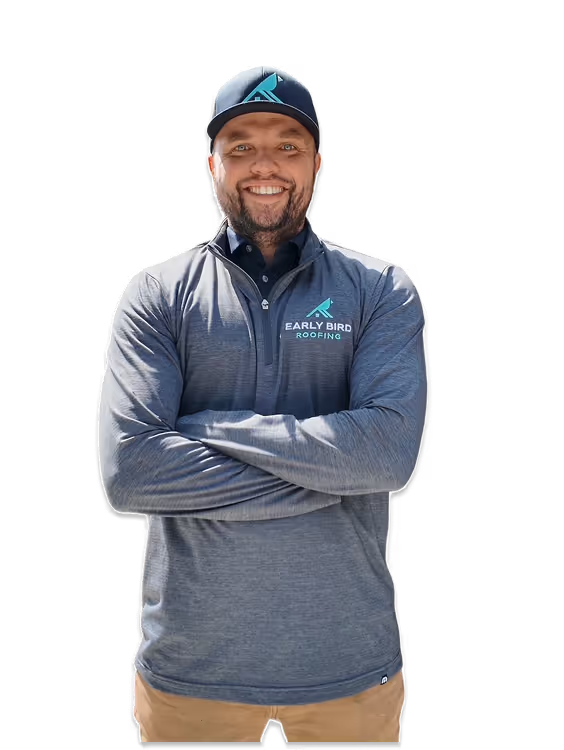
Matt Smith - Roofr of the Month - December 2025
Learn about Matt Smith, our December Roofr of the Month for 2025.

Roofing Project Management: How to Run Every Job Like a Pro
Learn how to manage roofing projects (from estimate to job scheduling, crew management, and payment) in this guide to proper roofing project management.
.webp)
Referral Partners and the New Rules of Marketing (with Michael Stearns)
Michael Stearns of Ascend Digital talks referral partners, AI marketing tips, and why chasing lead volume is the wrong approach for roofers.


More episodes
.png)
Insights from a Roofing Manufacturer (w. Larry Sernick at CertainTeed)
Larry Sernick of CertainTeed shares his thoughts on the roofing industry from a manufacturers perspective. Hear his take on Class 4 shingles, solar, selling retail, and slow storm seasons.
.png)
Cross-Training Crews to Survive Buffalo Winters (w. Chandler Pedini)
Chandler Pedini, our October 2026 Roofr of the Month, cross-trains his in-house crew on other trades to keep them busy year-round. Check out his story.
.png)
Physio Advice for Roofers: How to Prevent Aches, Pains, and Injuries
Physiotherapist Colby Bucci shares tips on how roofers can stay fit and safe on the job. We're talking stretching, rest, recovery, and treating yourself like an athlete.
