


If you've ever Googled how to build a roofing website, you know the advice is all over the place. Here's the truth: most roofing websites look the same, rank the same (poorly), and convert the same (worse).
Whether you're building your first site or looking to make your roofer website more SEO-friendly, this guide breaks down exactly what separates a high-performing roofing website from an invisible one.
Here are five website best practices to help you bring your site to the next level.
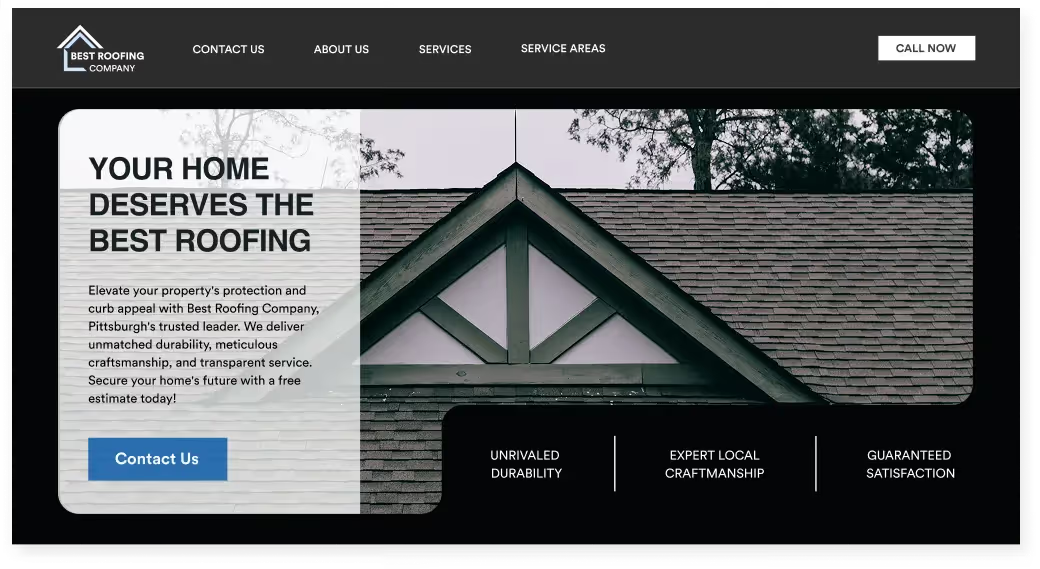
1. A clear, conversion-focused homepage
Your homepage has around 3 seconds to answer a user's most important question: "Can this roofer help me?" If they don’t get an answer pronto, they leave.
First impressions are driven by design elements like color scheme, layout, and visuals. These all signal whether you're a professional operation or an amateur. Homeowners make snap judgments based on these cues.
Here's what your homepage MUST have:
- Your service area (make it obvious!)
- A phone number or contact form above the fold
- Photos of real jobs (not AI or stock images)
- Customer reviews
- A clear call-to-action: "Get a Free Estimate" or "Schedule an Inspection"
- Trust signals: licenses, insurance badges, years in business
That’s it. Make sure that those elements are easy to find and take priority over everything else. That’s what your potential customers are looking for.
A clean, fast-loading homepage isn't just good for visitors. It's one of the most important signals Google uses to rank your site. Try to keep your website simple, effective, and junk-free.
And don't overlook accessibility: adding alt text to every image helps both screen readers and search engines understand your content.
2. Roofing website SEO pages
One of the most common questions roofing contractors ask is: how do I rank my roofing website on Google? It starts with having dedicated pages for each service you offer.
Instead of cramming everything onto one "Services" page, create individual pages for:
- Roof replacement
- Roof repair
- New construction roofing
- Storm damage & insurance claims
- Gutters, skylights, and other add-on services
Each page should target a specific keyword, like "roof repair in [your city]". Pages should also include a unique (and helpful) description of your process, and answer common homeowner questions.
Keep your target audience in mind as you write. A stressed homeowner dealing with storm damage needs different language than someone planning a new build.
That’s the foundation of how to make your roofer website more SEO-friendly: give search engines specific, valuable content to index.
3. Local SEO infrastructure
Roofing is a hyper-local business. Ranking for "roofing websites" nationally means nothing if you can't be found in your service area. Your site should be built for local search from the ground up.
These local SEO elements are non-negotiable:
- Your city and service areas mentioned throughout the site
- A consistent NAP (Name, Address, Phone) on every page
- A contact page with an embedded Google Map
- Location-specific landing pages (if you serve multiple cities)
- Schema markup for local businesses
- Google Business Profile listing
Many roofers skip all this entirely. That’s exactly why there's an opportunity to outrank competitors who built their site on a cookie-cutter template.
Use Google Analytics to track which pages are bringing in local traffic, and double down on what's working.
4. Fast loading and built for mobile
Over 60% of roofing searches happen on a mobile device. If your site loads slowly, or if the buttons are too small to tap on a phone, you're losing jobs before the conversation even starts.
For a mobile-friendly, fast-loading site:
- Compress and properly size all images
- Use a mobile-responsive layout (Most modern website builders do this for you)
- Eliminate unnecessary plugins, scripts, or page bloat
- Test your site at PageSpeed Insights (aim for a score of 70+ on mobile)
- Lower bounce rates by keeping important info (phone number, service area, CTA) visible without scrolling
Google's Core Web Vitals are now a direct ranking factor. So a slow site doesn't just frustrate visitors, it actively pushes you down the search results.
5. A system to convert your leads
Here's a hard truth:
Your roofing business can have great SEO, beautiful visual elements, and fast load times. And you’ll still lose leads if you don't have a proper system to capture them.
A good user experience matters just as much as getting the traffic in the first place. Your roofing website needs:
- An instant estimate or quote tool (homeowners want answers fast)
- Online appointment booking (not just a "call us")
- A contact page that's easy to find and fill out
- Customer reviews you can show off (Google, Facebook, BBB)
- Social media links (so it’s clear you're a real, active business)
This is where most roofing websites fall completely flat.
Getting traffic is only half the battle — converting that traffic into booked jobs is what actually grows your business.
Manage roofing website leads the right way
At Roofr, we built our platform to solve these exact problems for roofing contractors.
From instant estimates and custom proposals to an integrated CRM, Roofr gives you the tools to customize your website experience and make it work harder for your business. That way, you can focus on the jobs, not the admin.
Roofing website FAQs
Quick answers to your most frequently asked questions:
How do I make a roofing website? Start with one of the major website builders. Choose a mobile-friendly theme and build out pages for each service you offer. Make sure your contact page is easy to find, your design is consistent, and your site is optimized for local search.
How do I make my roofer website SEO-friendly? Focus on local SEO: include your city and service area on every key page. Create individual pages for each service, ensure fast load times, and build out a Google Business Profile that links back to your site. Track your progress with Google Analytics so you know what's working.
How do I rank my roofing website on Google? Ranking takes time, but the fundamentals are: quality content on dedicated pages, local SEO signals (NAP consistency, Google Business Profile), backlinks from local directories, and a mobile-friendly site that loads fast.
How many keywords should you target on a roofer's website? Each page should target one primary keyword and some closely related terms. Don't try to rank for everything on one page — a site with 10 optimized pages will outperform a site with one bloated page.
How much does a roofing website cost? A basic DIY roofing website can cost as little as $200–$500/year for hosting and a domain. A professionally designed site typically runs $2,000–$8,000 upfront. Some platforms (like Roofr Sites) bundle website tools into a business management suite.